🛡️ Make Your Regiment Proud
I was asked to share a one-to-two minute thought at our church men’s breakfast recently. I spent time praying about what to say, and landed on something I had been sitting with for a few weeks — an essay I wrote earlier this month on the oldest play in the tyrant’s handbook. The diagnosis: an epidemic of effeminate men, in society and in the church alike. The prescription: eat meat, lift weights, stop watching the BBC and CNN, read your Bible, fast intentionally, pray with other men. Because to my mind, the softening of men and the disarming of men are part of the same agenda.
But God had a different idea.
A thought landed in my mind shortly before breakfast that I hadn’t planned to share. And it changed everything I was going to say.
The Regiment
Here is something that always quietly fascinated me about the British military. The Royal Navy. The Royal Air Force. The Royal Marines. Notice anything? They are all Royal. The Crown is central to their identity.
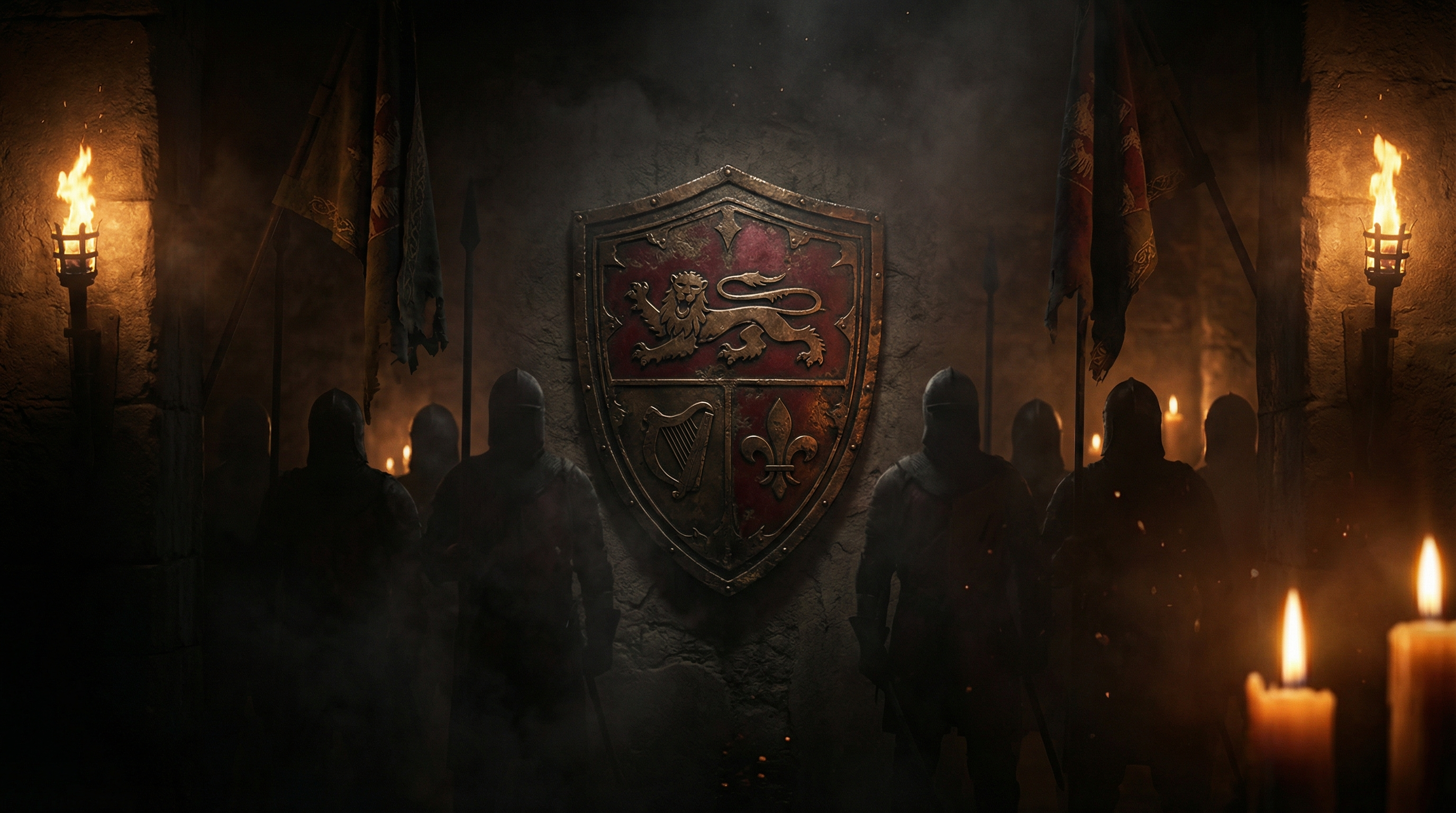
But the British Army is different. The Army is not Royal. The British Army is organised into regiments - many of them with histories stretching back three, four, five centuries. When a man enlists in the British Army, he doesn’t just join an institution. He joins a regiment. He eats in the mess hall surrounded by the battle honours of that regiment—captured enemy flags from wars fought long before his grandfather was born, silver trophies inscribed with the names of engagements that shaped empires, portraits of men who held the line when it cost everything. That is where his loyalty lives. Not to the Army in the abstract. To his regiment.
And this, military historians will tell you, is one of the great sources of the British Army’s strength. The regiment is the unit of identity. It is small enough to know, deep enough to love, old enough to carry weight.
Make Your Regiment Proud
During a particular war—I won’t name it, because my view of that war is complicated and I don’t want that to be the point—the commander of the British forces gave a speech before battle. It was not a rousing declaration about freedom or democracy or the grand sweep of history. He did not invoke geopolitics. He said something far simpler. Something that cut deeper:
Make your regiment proud.
That was it. Each soldier fights for the man next to him. Each man carries the weight of a regimental history stretching back generations. No soldier wants to be the one who broke under pressure when the regiment’s name was at stake. No man wants to be the coward whose failure is remembered in a regiment that has known glory.
The regiment becomes a kind of covenant across time—between the dead and the living and the yet unborn. You are not just representing yourself. You are representing everyone who carried that regimental flag before you, and everyone who will carry it after.
I find that extraordinarily moving. And I think it has something profound to say to Christian men.
Our Regiment
God gave us The Rock Church. He gave us our men’s group.
This is our regiment.
We did not choose one another the way you choose friends—by affinity or convenience or shared hobbies. We were placed together, in this place, at this time, in this local body. And that placement is not accidental. The church is the unit God chose. Not some abstract universal brotherhood, but this specific gathering of specific men, meeting in a specific place, accountable to one another in real time.
We have our own battle honours, though they are mostly invisible to the world. Men who fought addiction and won. Men who held their marriages together when everything screamed at them to quit. Men who brought their sons into faith. Men who stayed when it would have been easier to leave. That history matters. It shapes us. It obligates us.
And we have something the British regiment has only by analogy—the cloud of witnesses who have run this race before us, men of old who earned their commendation through faith, through whom God subdued kingdoms and stopped the mouths of lions. Our regimental history is the entire history of the church militant. That is a weight of glory worth living up to.
Fight for the Man Next to You
Christian men don’t fight for abstract causes. We fight for the man next to us.
You are not going to win your private battle alone. The man in the mess hall next to you—the one who is struggling at work, whose marriage is under pressure, who woke up this morning wondering if any of it is worth it—that man needs you present and strong. And you need him. This is not optional. It is structural. God built the church to work this way.
The regiment model refuses the idea that faith is a private matter between a man and his God, full stop. It is that—but it is never only that. A soldier in his bunk is not the same as a soldier in formation. Something happens when men stand together that cannot happen any other way.
So here is what I would have said, if we had not run out of time:
Make your regiment proud.
Carry your faith like a man who knows that others carried it before him, and others will carry it after. Fight for the man on your left and the man on your right. Do not be the generation that breaks the line. Shoulder to shoulder—this is how the Kingdom advances, and this is how Christian men are made.
TRC men—this is ours. Let’s not waste it.