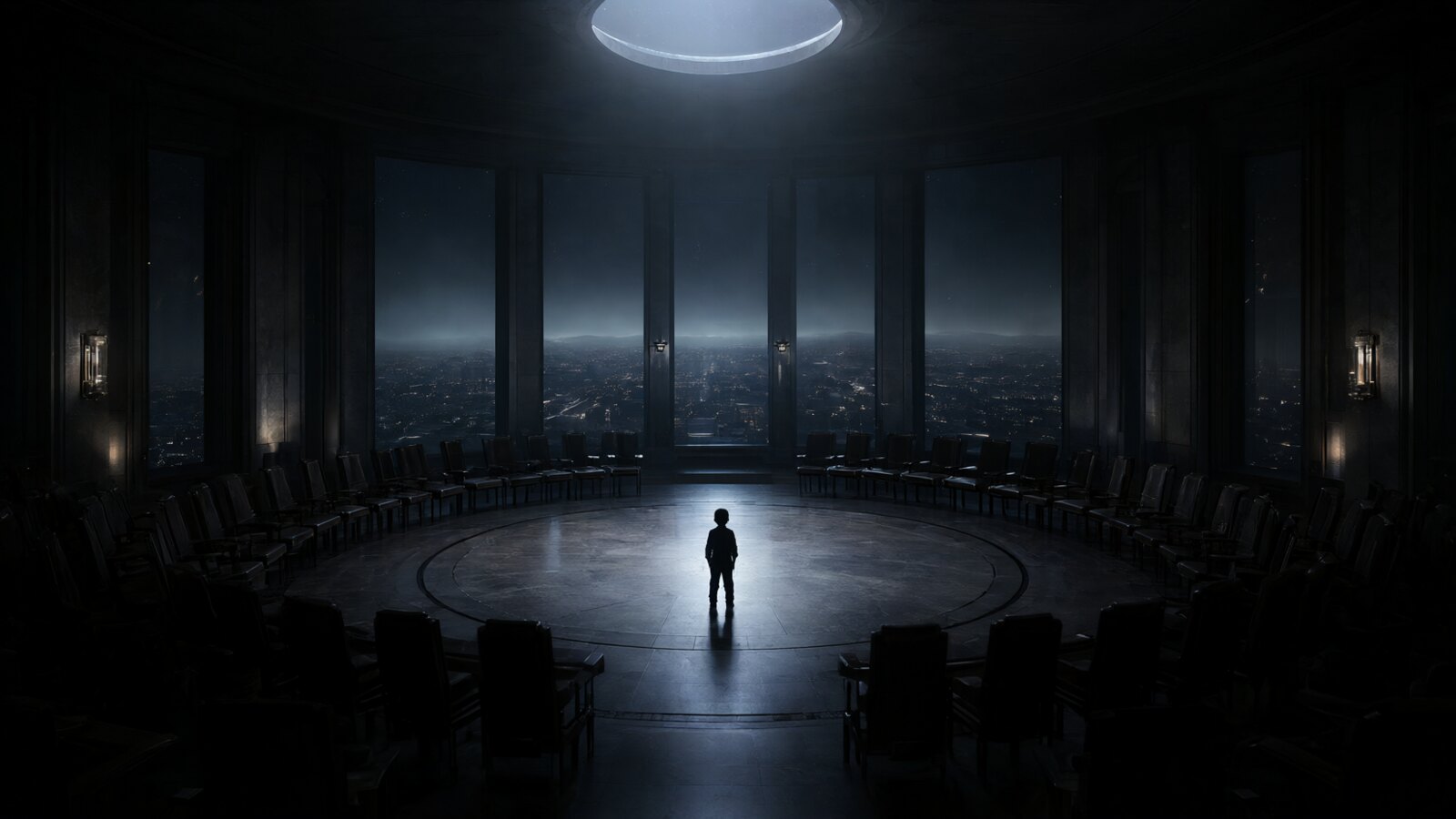
🏜️ The Boy in the Circle
On 29 October 2026 a single frame went up with four words across the top: The White male experience. A boy stands alone in the middle of a circle of elders, high above a city with no edge. He is nine. He was a slave last week. Every seat in that room carries a rank. He carries none.
That is the entire meme. Within days people were calling it the most culturally significant post of the year — not because it invented an argument, but because it translated one into the language a generation actually speaks.
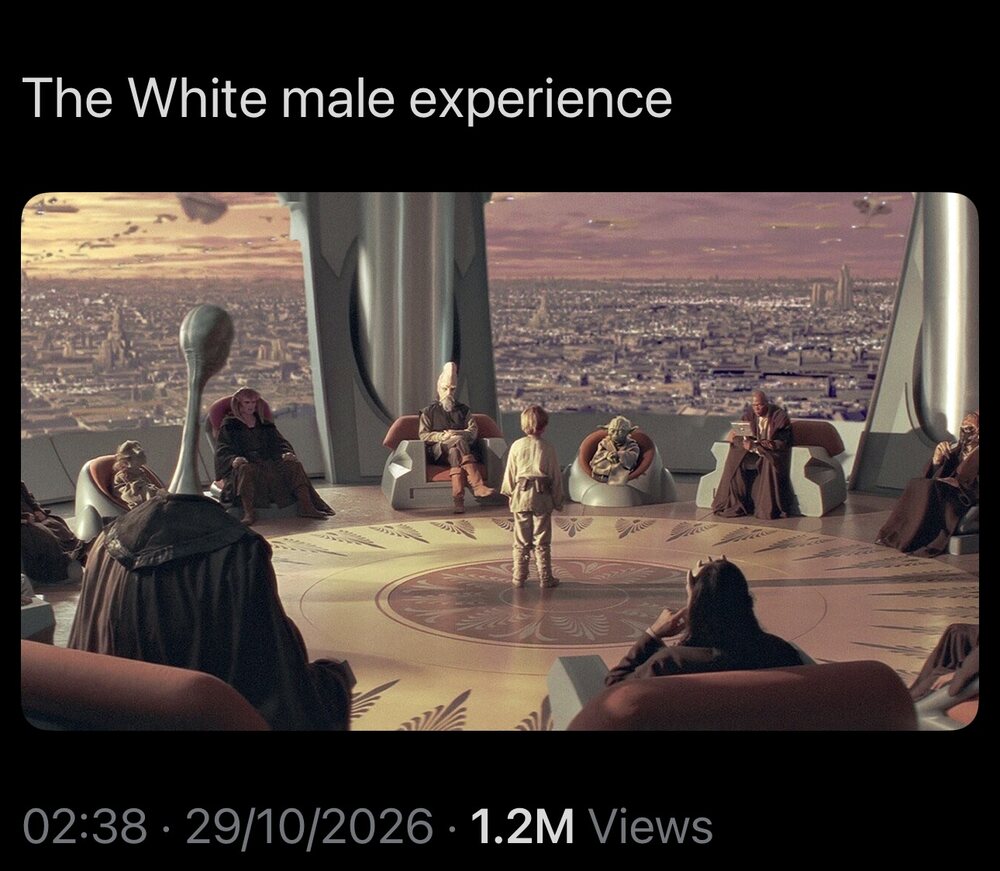
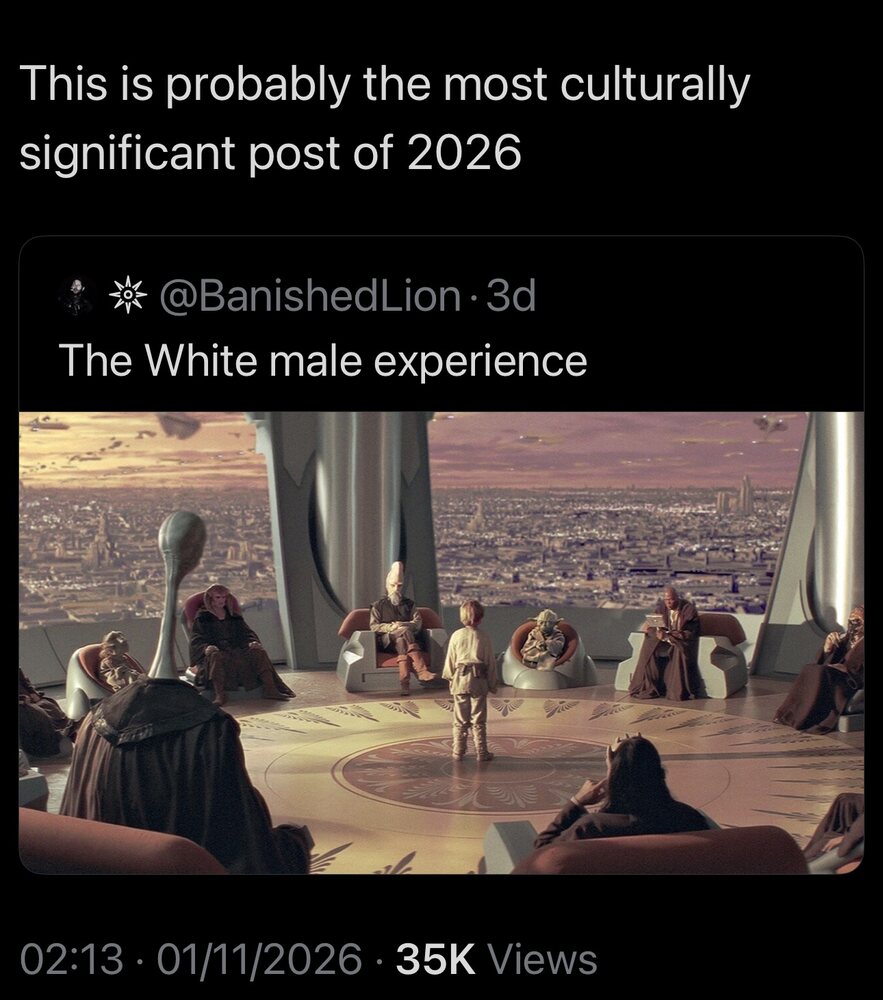
They did not need a new story. They needed a story they had already memorised, retold in the voice that is actually used on them. So here is the story, and then the retelling.
Who he is
Three films. One boy.
In The Phantom Menace Anakin is a child slave in a junk shop on Tatooine, a desert at the edge of the map. No father. No household. He is, inconveniently, a miracle: he builds a protocol droid from scrap, he podraces machines that kill grown men, and when Qui-Gon Jinn tests his blood the Force is thicker in him than in Yoda. The old prophecy calls such a one the Chosen.
Qui-Gon buys the boy in a bet and cannot buy the mother. Shmi stays behind in the shop. The Council refuses to train him — too old, too afraid, too attached. Too attached to his mother. That is the charge. A ring of centuries looks down at a nine-year-old and explains that his love for her is the defect, while she is still in the hands of men who can sell her. The order calls this detachment. Scripture calls it something else.
Ten years on he is the most gifted knight of his generation and the whole building knows it. He loves Padmé. He wants a house. He dreams his mother is dying. He goes back and finds her too late — freed, married, taken by Sand People, held for a month, dead in his arms in the tent.
Then he does the thing the meme will not let go. He kills them all. Not a duel: the camp. Men, women, children. They’re like animals, and I slaughtered them like animals. The film means it as a man falling into hell, and I do not read it any other way. But the meme does not dispute the fall. It asks a different question: what was the respectable alternative supposed to be?
The hearing
The Council’s verdict in the film is dressed as care: too old, too angry, too attached. The meme assumes that was the version written down, and reconstructs the real hearing.
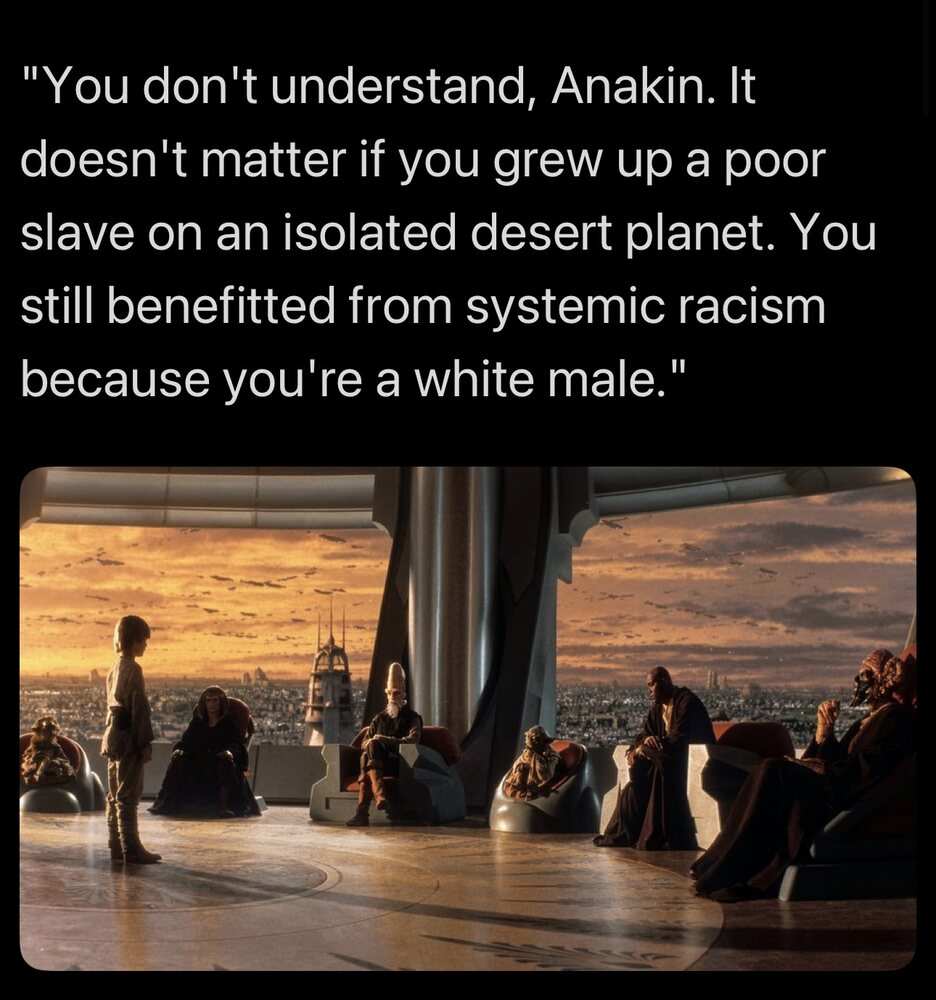
Read it slowly, because the joke is the order of the facts. Born a slave. Desert planet. Still the beneficiary. Nothing that happened to him enters the finding. The charge is categorical — what he is, not what he did. A ring of elders, arranged by species and age around one human child, rules that his biography is irrelevant to his guilt. This is why the picture needed only four words. The chamber already looked like the meeting.
And what he wants is not power. Power is what a man takes after the ordinary wants have been criminalised.
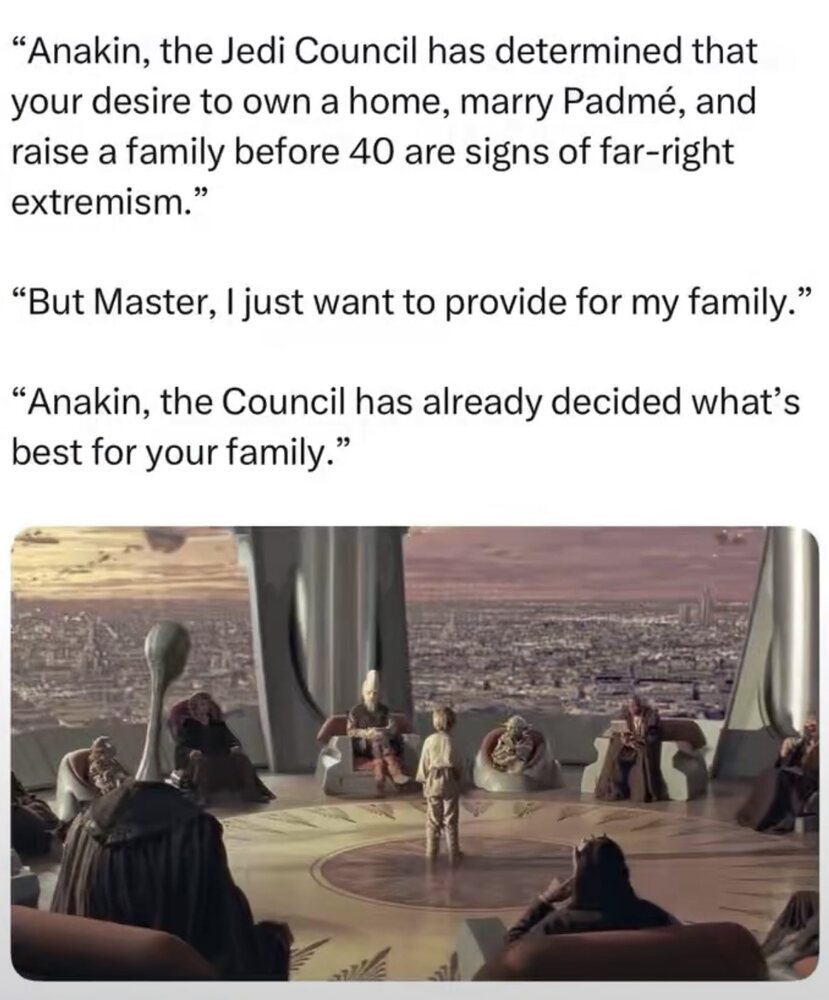
A home. A wife. Children before he is forty. The means to provide for them. In the film the ban is “attachment,” dressed as spiritual discipline. In the meme the same ban is reissued in the language of a modern state, and a man wanting a household is refiled as extremism.
Here the mask slips, because Scripture is not vague. “If anyone does not provide for his own, and especially for those of his household, he has denied the faith and is worse than an unbeliever” (1 Timothy 5:8). “A man shall leave his father and his mother and hold fast to his wife” (Genesis 2:24). The qualification for spiritual authority, in that same letter, is not distance from a household but faithfulness inside one — a man who “manages his own household well” (1 Timothy 3:4). The Council forbids the marriage, despises the household, withholds the rank, and calls the arrangement virtue.
It is not virtue. It is a counterfeit of it: detachment with the object quietly removed. Christ does command a sword against the dearest loyalties of this life — “whoever loves father or mother more than me is not worthy of me” (Matthew 10:37) — but He demands that surrender to Himself, the living Lord who keeps the particular. The Council demands it to itself, and keeps nothing.
The elders doing the filing are not young. That is the other half of the grievance, and it has a chart.
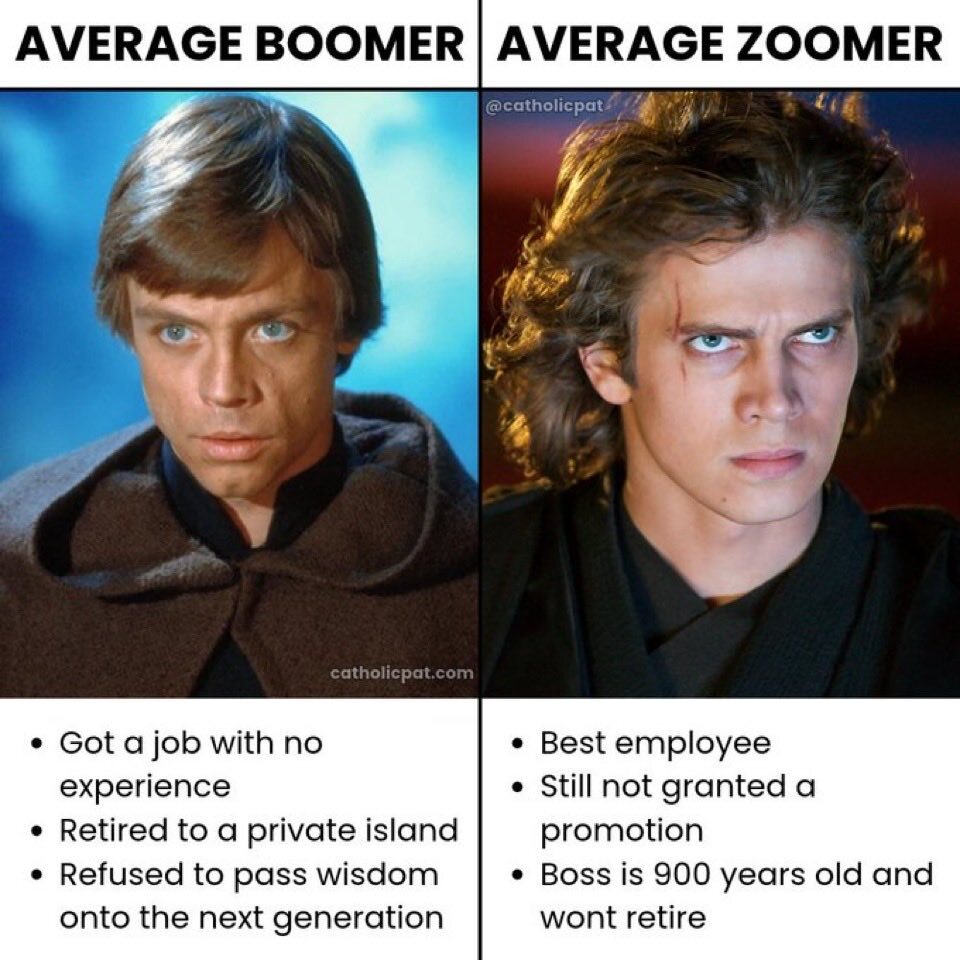
Luke, left, is the golden boy: fell into the job with no experience, retired to a private island, declined to hand the order on. Anakin, right, is the best man on the payroll and the rank is still withheld. The boss is nine hundred years old and will not retire. Yoda is literally nine hundred. Every promotion panel I have ever sat near is this chart in costume.

“It’s over, Anakin” becomes a pay stub: sit in the house I bought on one income, hand the retirement out of your wages, and call the arrangement the moral high ground. The answer under the second face is the whole politics. No.
The mother
Now the part the meme cannot leave alone.
Bandits took his mother, held her, killed her. The meme asks what the respectable response was, and puts that response in the mouth of the friend — Obi-Wan, who loves him and talks like a press office. That is the sting. The scolding does not come from the villain. It comes from the man who should have been riding with him.
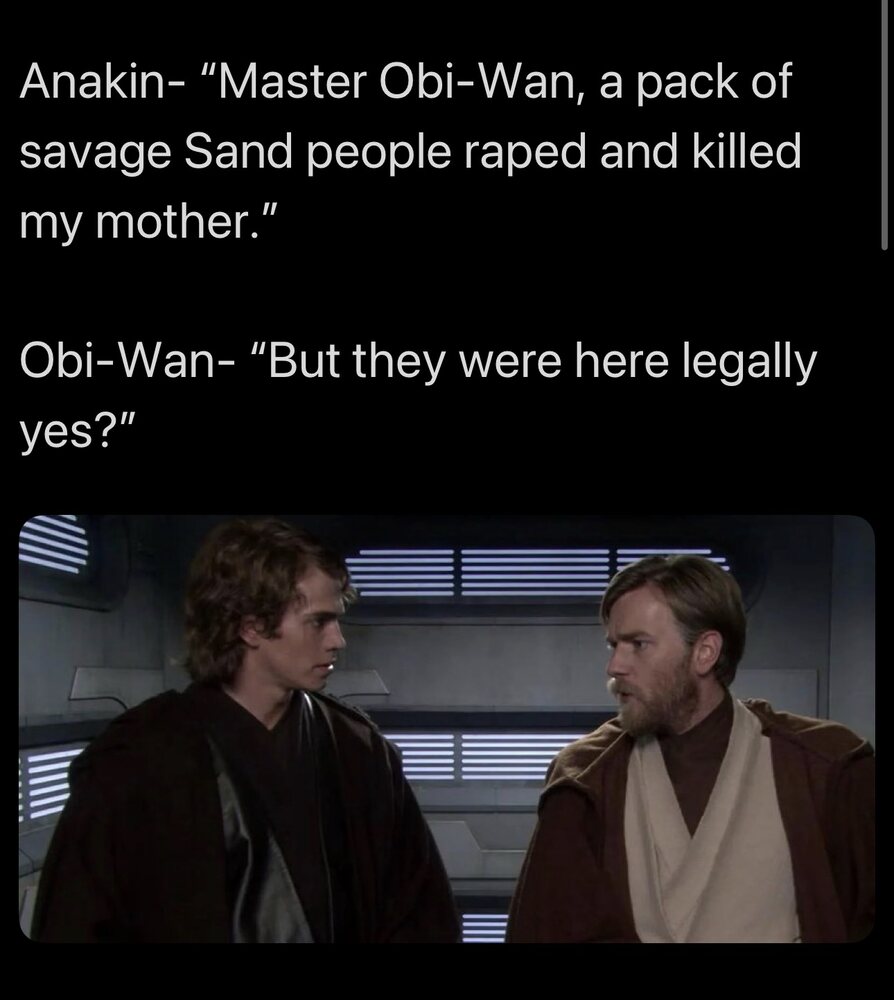
Legality first. If the papers are in order the moral question is closed, and what they did to her becomes a downstream detail of a policy already settled in a nicer room.
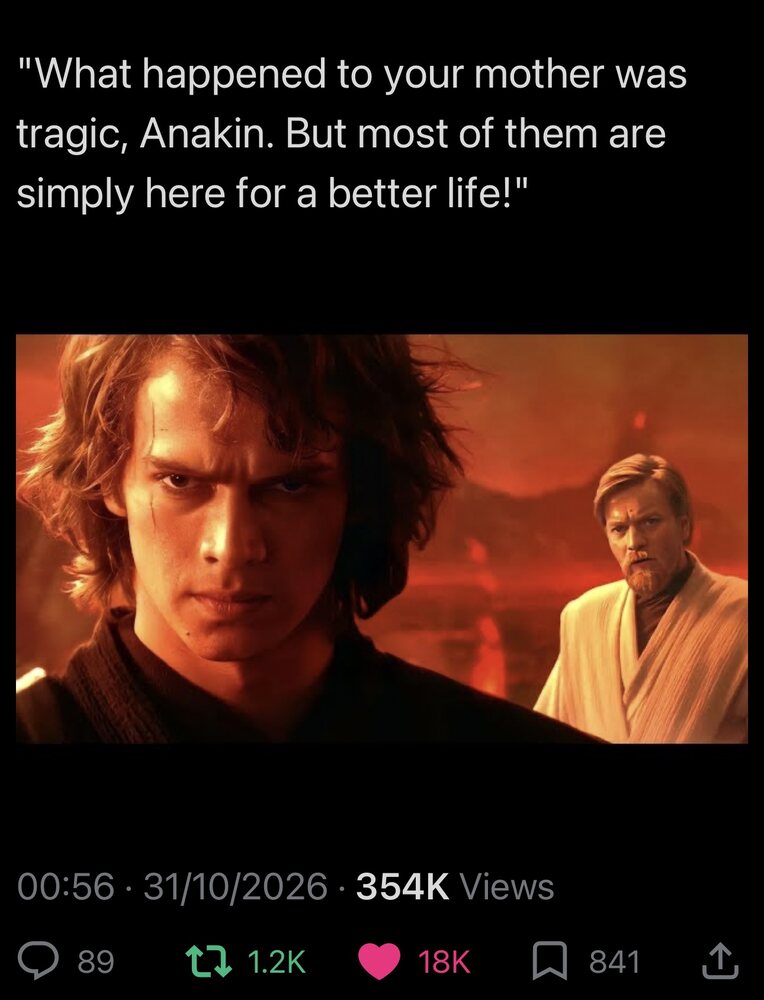
Then motive: tragic, and most of them are here for a better life. Four moves and the corpse has been absorbed into a story about other people’s aspirations. The word “most” does the work of the whole sentence — it concedes a remainder of the guilty and then rules that the remainder governs nothing. He has just come from the camp. He is not shopping for a remainder.

Then cuisine. Your mother is dead, and the rebuttal is a menu. The planet is a desert; the food was never the point of the desert. The joke lands because every man in this country has heard that exact sentence, in that exact voice, about a neighbourhood that changed and a country that changed — and has been told that noticing the change is the moral failing.
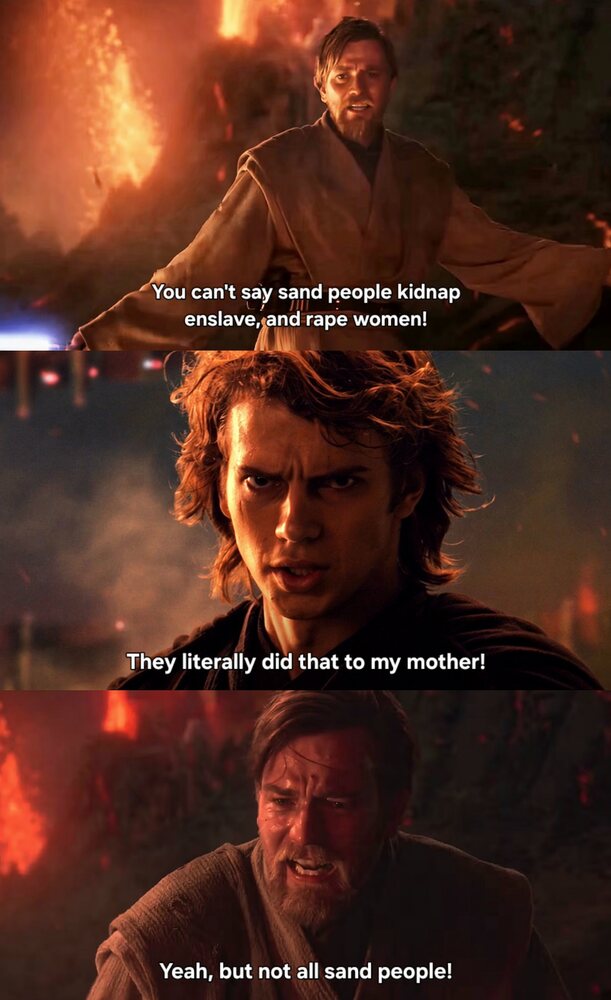
Then the slogan that ended argument for a decade, handed back to the man it was used on. You cannot say it. They did it to my mother. Yes — but not all of them.
“Not all” is the high ground in four words, and it is a refusal to speak of a pattern. Our Lord gave the test: “you will know them by their fruits” (Matthew 7:16). A pattern of fruit is a statement about a tree, not a libel against every branch. Yet the only group-claims the Council permits are the ones aimed down at the boy. A white male slave benefits from systemic racism. Sand People come for a better life. Both are group claims. Only one is allowed to organise a policy.
And once the costume comes off, the forbidden teaching is not about the Force at all.
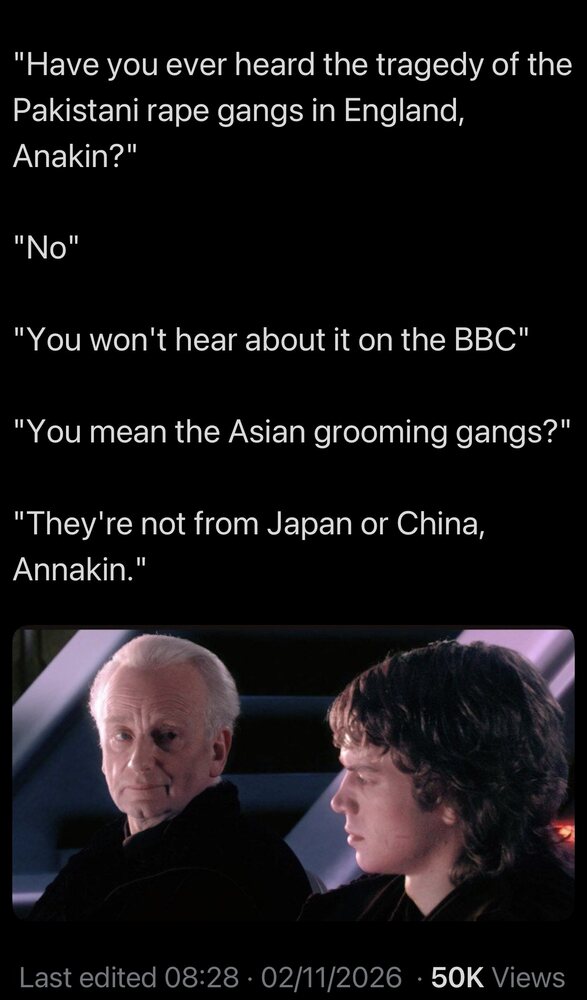
Palpatine’s tragedy in the film is Darth Plagueis, who could keep the people he loved from dying — a power, he says, that can be learned, but not from a Jedi. In the meme the forbidden knowledge is a fact about England. You will not hear it on the BBC. Call them “Asian” and you may say it; they are not from Japan or China.
This is Rotherham, and Rochdale, and Telford, and the inquiries that finally admitted what the institutions had been managing: gangs of men, overwhelmingly of Pakistani heritage, abusing white English girls while the noun was adjusted and the policy protected. The girls were the mother in the tent. A whole press existed to make sure that a good person, asked whether he had heard, could answer honestly: no. I have written about those inquiries and the men the state decided not to see — the report, the numbers, the pattern.
That is what the second wave of this ideology actually is. The first wave was a language war about the past: confess a privilege you never had. The second is bodies and borders. Open the country, rename the consequences, and when the consequences settle into a pattern, widen the noun until the pattern disappears. The food meme is that policy described by a man expecting gratitude. The BBC meme is the same policy described by a man who has read the inquiry.
The high ground
Which brings them back to the volcano, where the film had already staged the divorce.
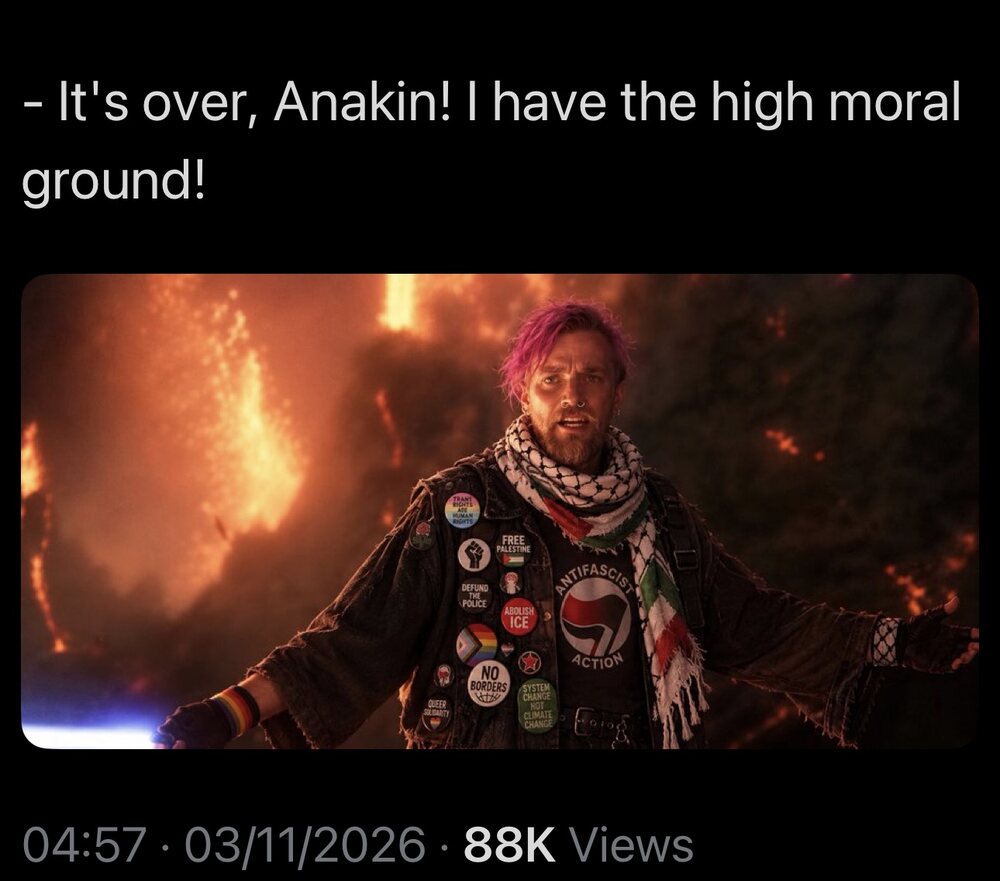
“I have the high ground,” says Obi-Wan, and the meme changes one word — moral — and dresses him for the claim: no borders, abolish the agency that removes people, defund the police, a foreign cause around his neck, the climate and the sexual politics worn like medals. He is sincere. Sincerity is the point. He believes he has earned the lava by being good.
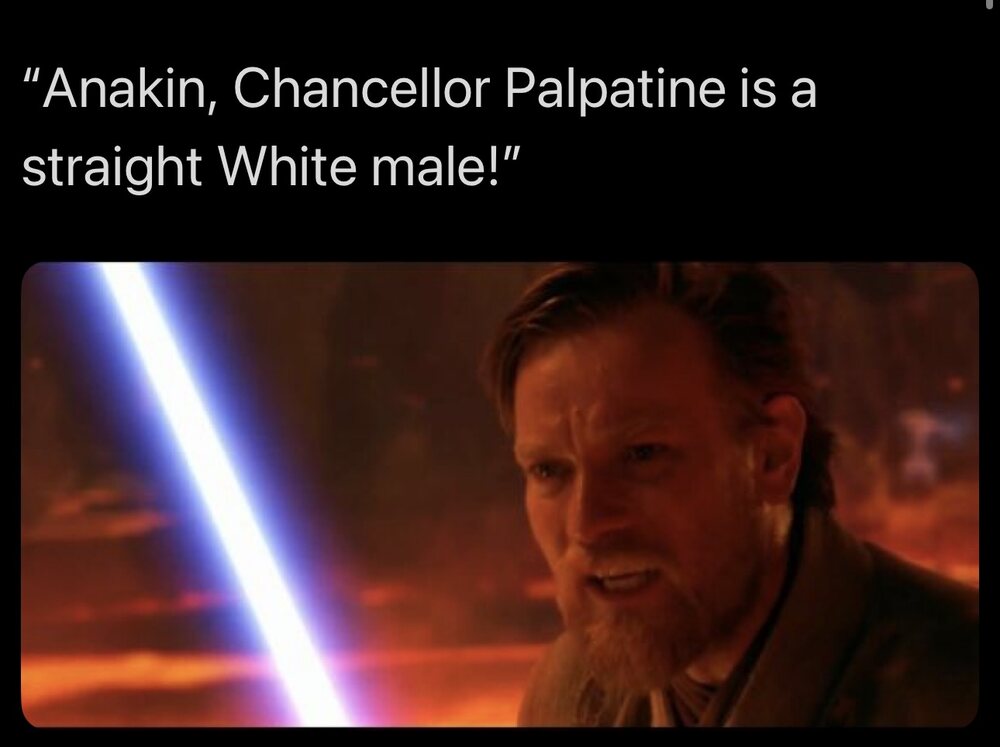
And the indictment underneath, once the outfit is off, is not that Palpatine engineered a war or serves the dark. The charge is that he is a straight white male. Full stop. The disqualifying fact is the category — the same category as the boy in the circle, grown up and still not granted the rank. Everything else coheres once you see it: if the charge is categorical, then evidence about mothers and camps and inquiries and pay stubs is beside the point, and beside the point is exactly where the Council has been putting it since he was nine.
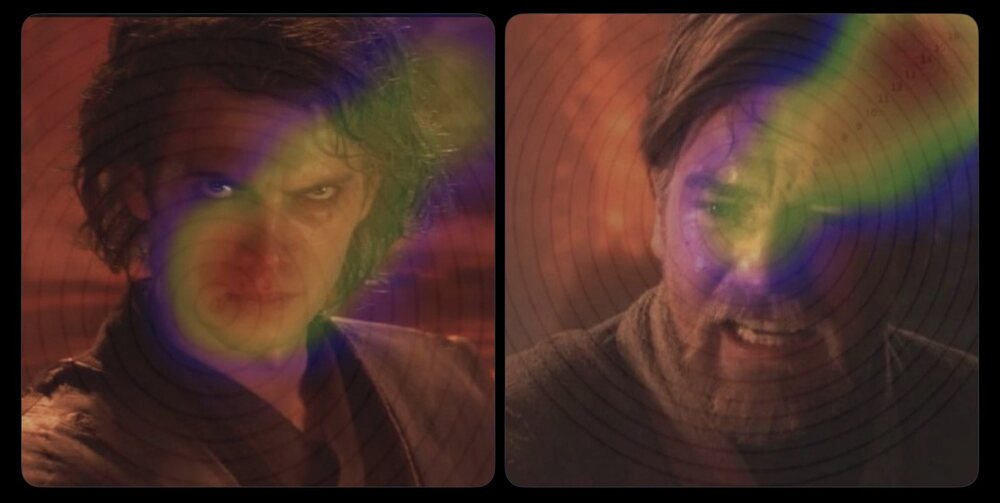
No caption needed. The duel has been lifted off the volcano and put under a lens that sorts faces. The culture cannot watch two men argue about a murdered mother without first deciding what each face is allowed to mean.
The order of loves
Under the jokes there is a doctrine, and one post states it without a word of Star Wars in it.
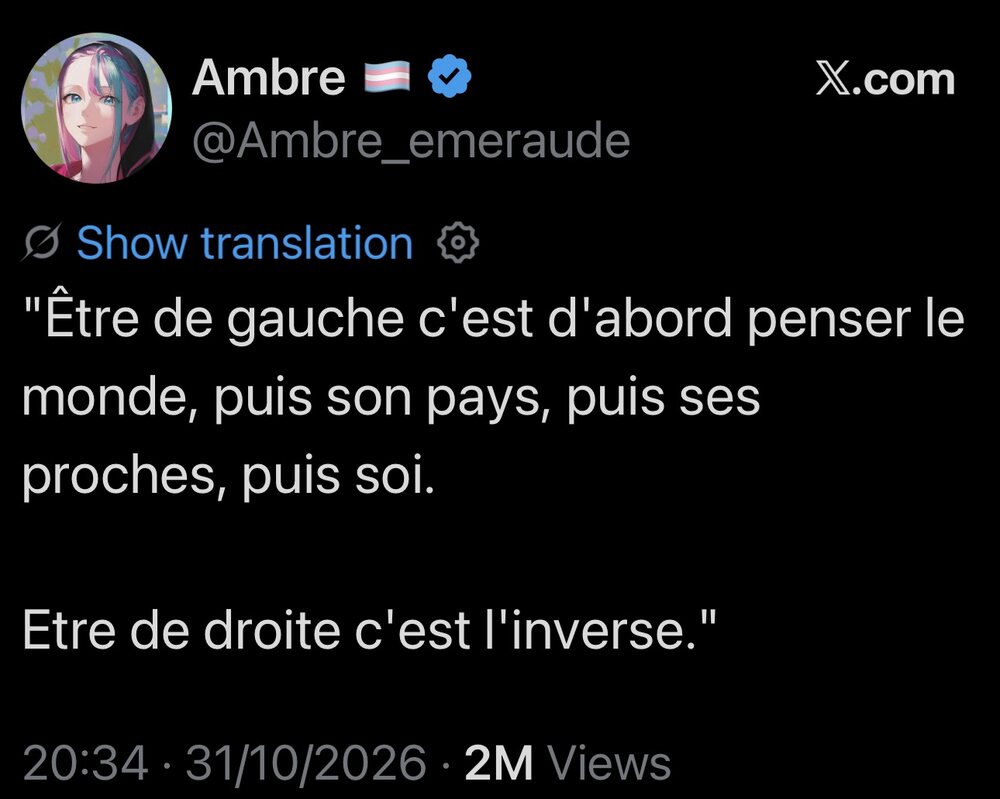
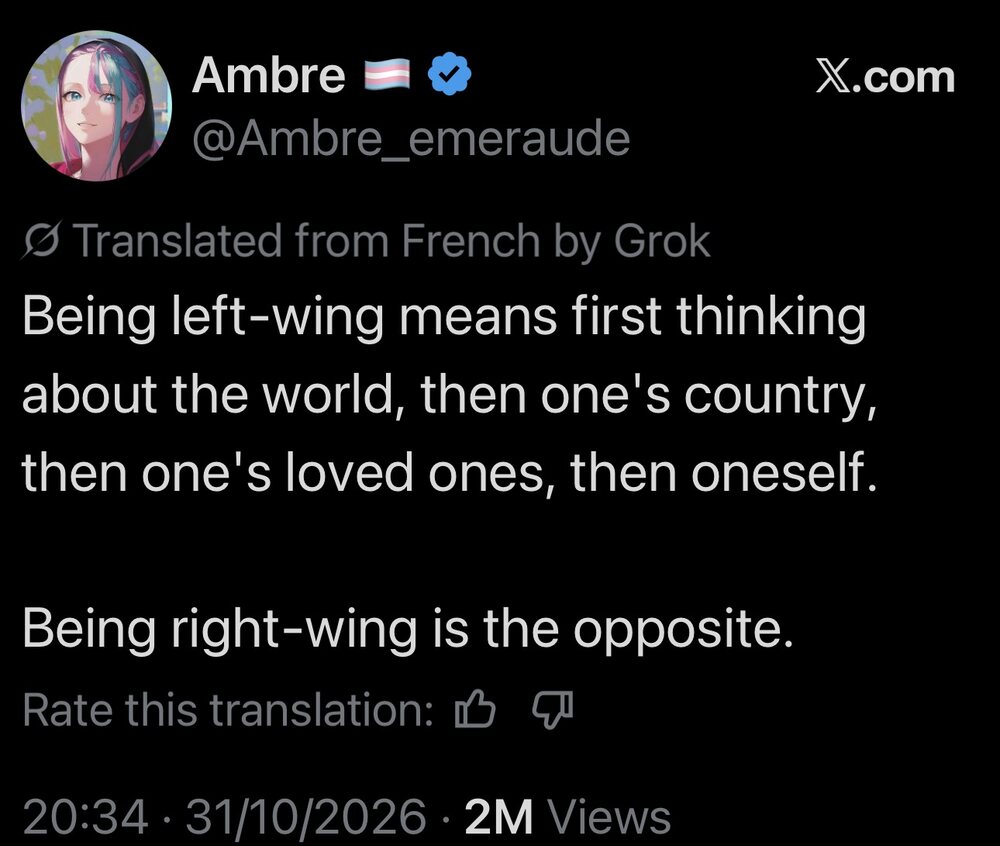
The world, then the country, then one’s own, then oneself — that is the left, in this formulation. The right inverts the list. The old name for the argument is the order of loves, and the older name still is Scripture. A man who loves rightly does not love the abstraction first and the particular last. “If anyone does not provide for his own… he has denied the faith” (1 Timothy 5:8). The near ones, whose names he knows, come before a species, a galaxy, a procedure. Anakin’s list is his mother, his wife, the child he is trying to keep alive, and then, a long way after, the Republic. The Council’s list is the Order, the balance, the Code, and underneath, if there is room, a person. The Council calls its list holiness and his list the dark side.
The nations belong to that order too, and are not an accident of it. God “made from one man every nation of mankind… having determined their appointed times and the boundaries of their habitation” (Acts 17:26). A border is not a sin to be repented of; it is a providence to be honoured. A government that dissolves the borders is not being generous with its own property. It is spending a patrimony it did not earn, on terms the inheritors never agreed to.
Put the French post beside the food post and they are one post. A man who thinks of the world before his mother will tell you the food is blander without the people who killed her, and he will be proud of the sentence, and he will experience the pride as moral high ground. Anakin’s “no” on the pay stub and Anakin’s slaughter in the camp are the same refusal at two volumes. The order of loves has been inverted on him, and he inverts it back.
The speech rules exist to protect the inversion.
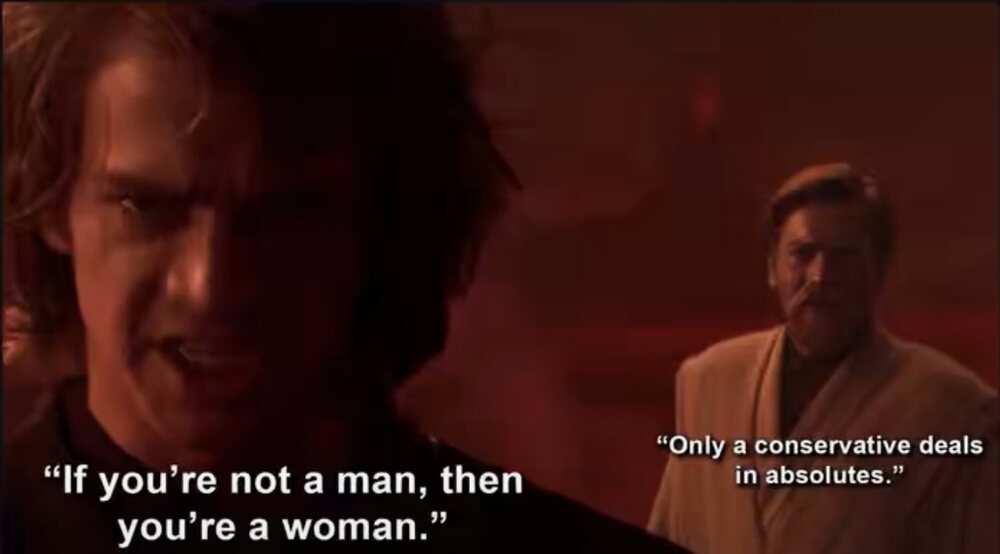
“Only a Sith deals in absolutes,” says Obi-Wan, dealing in one. The meme swaps the noun. If you are not a man you are a woman — a binary, stated flat — and the reply is not a counter-example but a category: only a conservative deals in absolutes, and conservative is the current word for Sith. The label does the work the argument used to do.
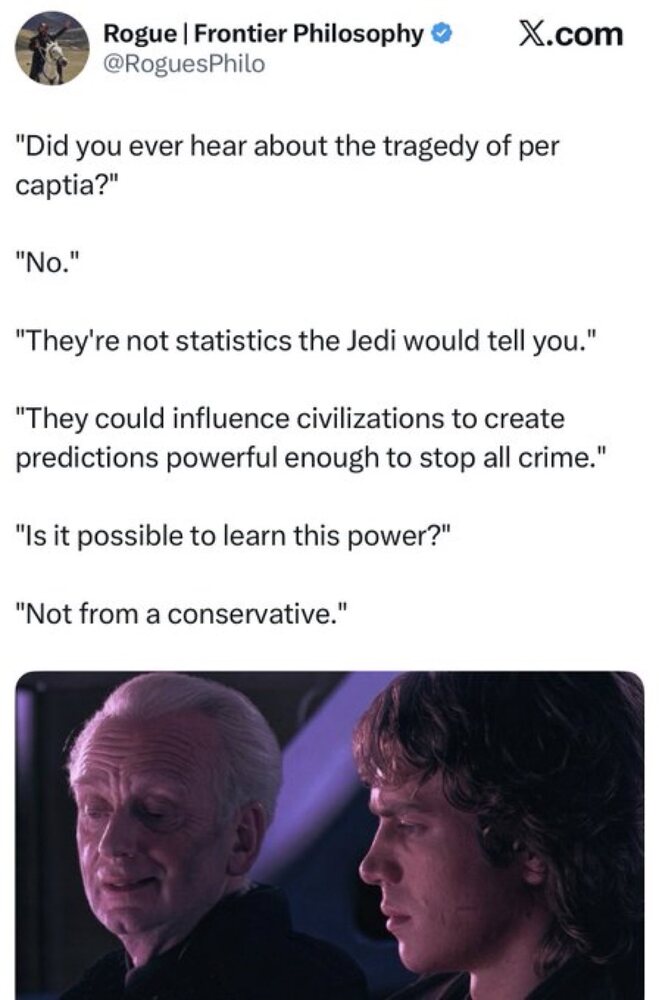
Numbers get the same treatment. Per capita is the forbidden power: one group’s rate set beside another’s will reorganise a civilisation faster than a sermon, so the Jedi prefer the sermon, which cannot be checked. “They’re not statistics the Jedi would tell you.” Of course they are not. A statistic is a specific word with a denominator. You may say the suffering is tragic. You may not say the rate.
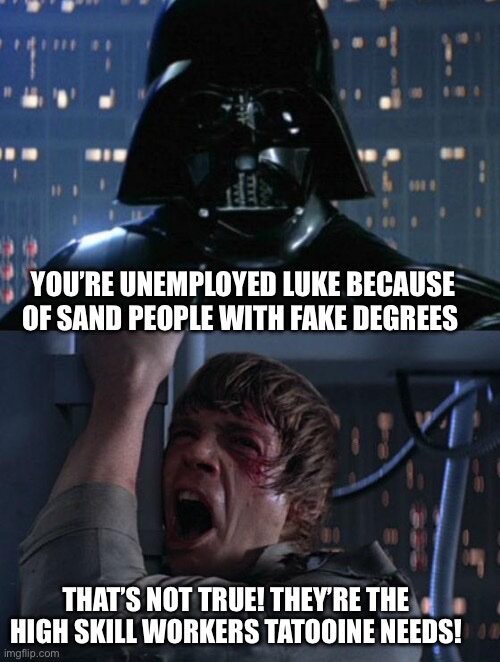
And when the rate is about wages, the sermon returns to the labour market: they are the high-skill workers Tatooine needs. The same structure as the food, the legality, the better life — a concrete harm, named by the man carrying it, answered with the importer’s brochure. Fake degrees are the brochure’s fine print, the thing you are rude for having checked.
What they call him for noticing
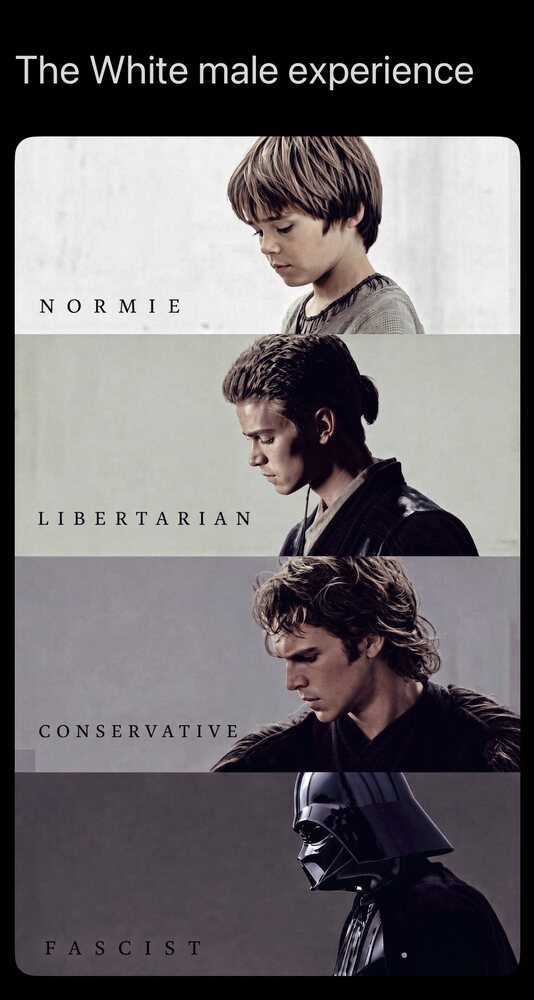
His life in four words: normie, libertarian, conservative, fascist.
The child with his eyes down has not spoken yet. The padawan beginning to be competent, and beginning to resent the men who will not say so, is a libertarian: let me build the droid, let me race, let me keep what I earn, let me have my mother. The young general who found the camp and came home married is a conservative: he wants the house, the wife, the child, and his own border held against the people who raid it. The helmet is the fascist — and the helmet is just the face, once the Council has run out of intermediate words.
Nothing in that chart is a change in his ability. The gift is constant. What changes is how much of the arrangement he is still willing to defend. He grew up poor, and the system that kept him poor now needs him to bleed for it. The chart is a man crossing out names as he stops defending it. The people who made it think the bottom square is a warning. The people who share it know the bottom square is what you are called when the first three descriptions fail to make you sit down.
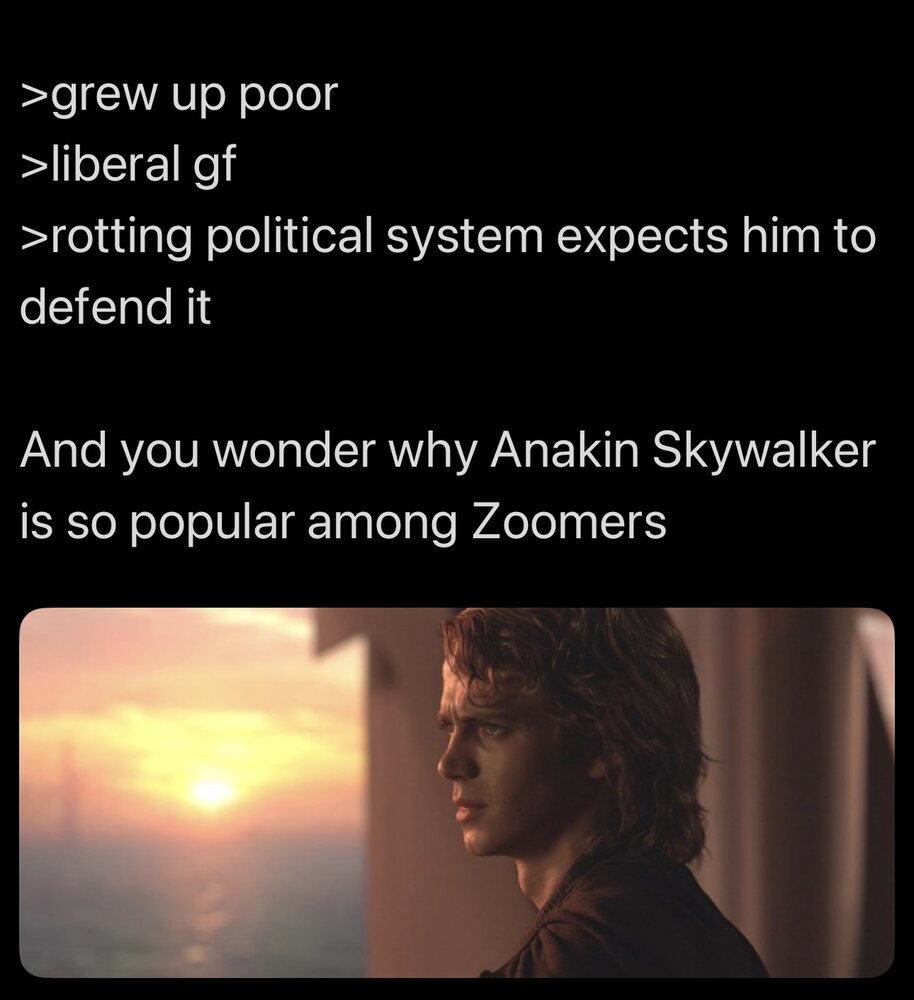
Grew up poor. A girlfriend who loves him and still believes the system can be appealed to. A rotting order that expects him to fight its wars and repeat its lines. And you wonder why the zoomers put Anakin on the wall.
They are young men raised inside an order that had already circulated the memo on them. The memo said the chamber was diverse and the boy was the problem. It said his wanting a wife and a house before middle age was a political symptom. It said the men holding the ranks, the houses and the pensions had earned them, and that his failure to hold them was a personal defect to be corrected by importing someone more grateful. It said that when a pattern of crime fell on girls who looked like his mother, the moral act was to widen the noun and keep the policy. It said all of it in the voice of Obi-Wan — sad, fond, disappointed, already certain of the high ground.
They do not hear that voice as kindness anymore. They hear the hearing.
The meme does not ask them to admire the helmet. It tells them the helmet was always the Council’s word, waiting at the bottom of the chart — and that the chart was written the day a boy stood in a circle and told the truth about his mother.
He killed them. All of them. The Council is still talking about the food.
The boy is still standing there.
And there he will stand until the true Judge sits — the one who does not despise the particular, who numbers the hairs and knows the names, who will say to the men who managed nouns instead of loving neighbours, “I never knew you” (Matthew 7:23). Every false high ground is taken from them in the end. The lava takes it first.
Maranatha. Come, Lord Jesus.