🚀 DSEC 2023: Grief, Grit, and God’s Win
I attended my second DSEC—the Data Science and Engineering Conference—this past week (November 7–9, 2023). The event began in 2022 as a way to build cohesion within the bank’s rapidly growing digital innovation team, mostly made up of twenty-somethings fresh out of university. This year, as last year, a handful of spots opened up for people outside the core team—and by God’s grace, I was in.
The conference runs for three days at the Royal Bank of Scotland’s headquarters campus in Edinburgh. Day one is keynote talks, external speakers, and structured networking. Days two and three are the Hackathon: teams of five, thirty-six hours, one brief and one working demo.
Last year was my first time at the Edinburgh campus—my first work trip in seven years of UK employment—and I remember walking those grounds with a full chest: gratitude, expectation, the particular aliveness you feel at the beginning of something. I was praying constantly under my breath. Pure joy.
—-
The Heaviness That Surprised Me
This year, the company could only send me for the Hackathon days. So instead of taking the train from King’s Cross the way I had the year before, I caught an easyJet Tuesday evening and arrived just in time for Day 2. Walking across the campus again toward the conference building, something hit me that I was not prepared for.
Grief.
Not sadness. Grief—the kind you feel in your chest and your throat. That sense of aliveness, that full-chested gratitude and expectation from exactly twelve months earlier? It felt distant now. Faded. The Scotland autumn was doing what Scotland does in November—bare trees, grey cold, fallen leaves—and walking through it I had an honest reckoning: I am turning forty. I am not the person who can run on vision and expectation alone anymore. Something had changed, and the contrast with the previous year made it impossible to ignore.
I have never felt grief that physically before. It sat in my throat like something you cannot swallow. But I did not try to push it away or manage it. I let it stay. I prayed through it. I told God this is what I am feeling right now and asked Him to hold it with me. I had enough self-awareness to recognize that a healthy person can and should feel things like this—that the valley is as real as the summit—and so I just let it pass through me.
It did pass. And what came on the other side of it makes me even more grateful for those dark few minutes on the Edinburgh campus.
—-
The Hackathon
This year’s theme was ChatGPT—specifically, how could generative AI be applied to solve a real problem inside our bank?
The timing was almost absurd: OpenAI had held its very first DevDay announcement the evening before the Hackathon began. I watched the entire fifty-minute presentation on my phone during the flight up to Edinburgh, taking notes. I arrived knowing things about the direction of the technology—custom GPTs, the new “GPT” terminology, the practical roadmap—that most of my competitors simply did not know yet.
When our team of five sat down, the first thing I did was go to the whiteboard and write out all seven judging criteria in large letters. The scoring was straightforward: seventy points total, ten points per criterion. Only one of those ten points was for the originality of the idea. The rest were for execution, presentation quality, demonstrated business value (actual £ figures), and concrete risk assessment. Most teams, I suspect, poured everything into coming up with a brilliant idea and hoped the rest would follow. We decided from the first minute that we were going to earn all seven boxes.
The initial idea-selection process was brutally honest. We were all male engineers, which meant nobody took sharp criticism as a personal attack. We just argued on the merits. One team member—Andreas, Greek, sharp—kept pushing an idea I thought was genuinely terrible. I told him so, point by point, without softening it. He took it well. By 11:30 PM, two and a half hours in, we had landed on exactly what we were going to build and divided the work clearly.
That kind of clarity in the first session is rarer than it sounds. Last year my team—three women in their early twenties, me, and one other—could never reach it. We pulled in different directions the entire time. That is ultimately why we were eliminated in the first round despite having, in my view, a better product than the team that won.
This year: different story entirely.
—-
The Team
Brian, who looked to be in his fifties, introduced himself at the start by admitting openly that he was not a technical person—but that he had twenty-plus years of banking experience and would do anything that helped. I handed him the presentation deck. He ran with it. I had to redo most of it later, but Brian was our anchor: steady, enthusiastic, always making everyone feel that what we were doing mattered.
The two colleagues from my own department came in already knowing how I think and work. The final fifth—solid, sharp, easy to be around.
By the first evening we had made a pact: we would not go to the hotel until we had a working demo. At 7:00 PM, the demo ran for the first time. We went to bed.
Day 2 was entirely about the presentation—polishing slides, cutting every unnecessary pixel off the shared screen, running five-minute timed rehearsals again and again, giving each other feedback without mercy, incorporating it without ego.
I should mention: Wednesday was my weekly fast day, which meant I sat in front of a full hotel breakfast buffet—scrambled eggs, pastries, the works—and drank water. On an empty stomach, running nothing but the Holy Spirit and cognitive load, I actually thought more clearly than usual. There is something about fasting that quiets the ego in a way I cannot fully explain. No matter how pointed the disagreements got in that room, nobody crossed a line. Nobody snapped. The sharpest debates stayed clean. I think the fast had something to do with that.
—-
The Win
In the first-round group stage, we listened carefully to every piece of feedback from our judges and immediately updated the deck before the final round. For example, one judge suggested we put a one-line summary of the tool on the opening slide. We added it before we walked back in: “A GenAI Model Validation Assistant Tool.”
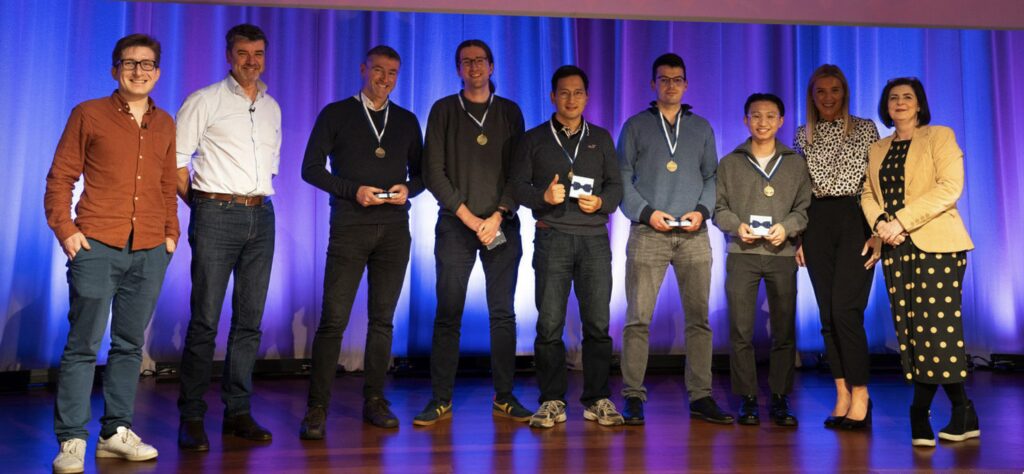
The final result: all four judges selected our team unanimously. We learned afterward that none of the other teams that made the final four had thought to align their work to all seven criteria from the beginning.
Our projected numbers: approximately £230,000 to deploy the tool; an estimated £14 million in benefit to the bank in year one alone. The judges did not dispute the figures.
The prize for the winning team? A £50 Amazon voucher.
I’m not complaining. I’m grateful.
—-
Looking back, God’s hand was in so many details: the OpenAI DevDay video I watched on the flight, the team composition, the Wednesday fast, the decision to put the judging rubric on the whiteboard in the first ten minutes, the working demo at 7:00 PM, the final-round feedback we actually listened to.
And I think about that grief I felt walking across the campus on Tuesday evening. God gave me a full-on rollercoaster—grief in the valley, joy at the summit—and through all of it, not a shadow of turning from Him.
All glory to God.