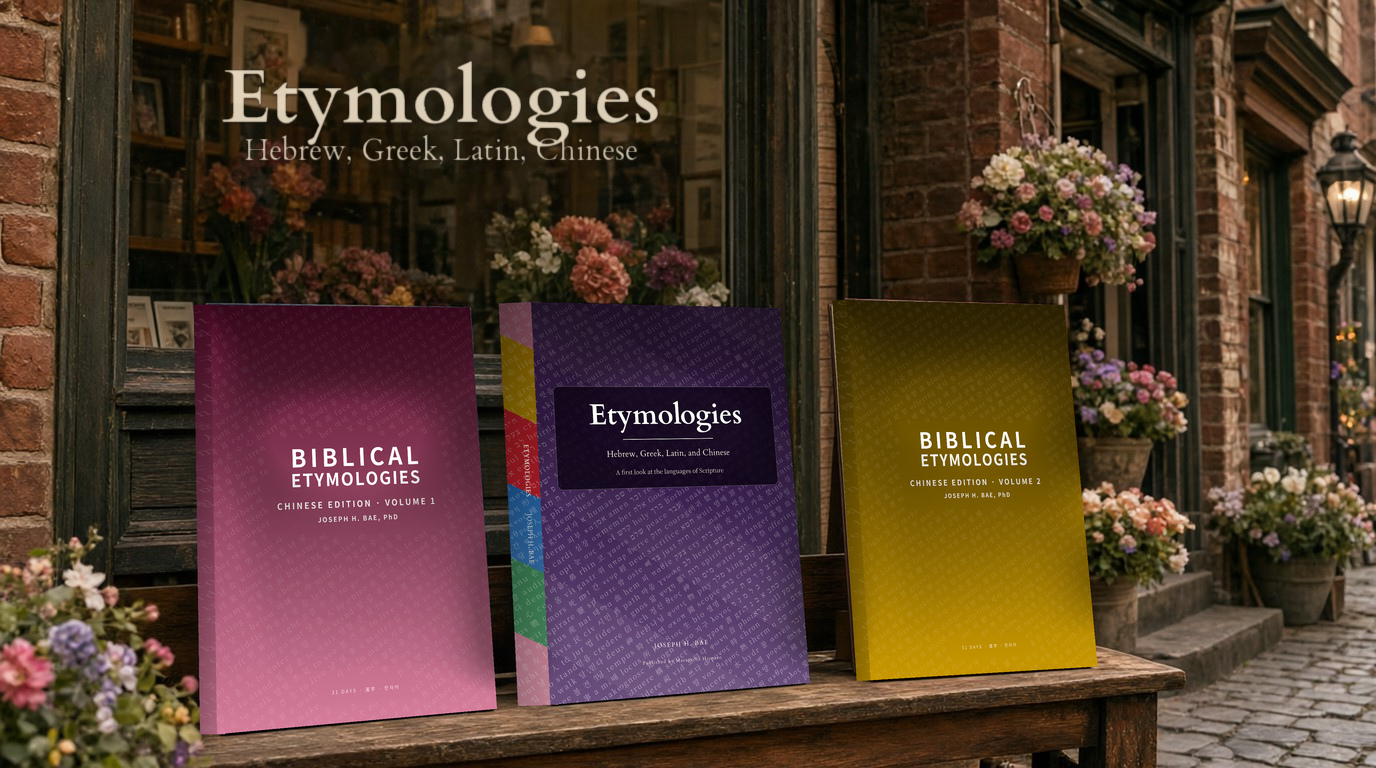
📖 Eight People in a Boat
📕 Etymologies — Hebrew, Greek, Latin, and Chinese
412 pages · five courses of thirty-one days · paperback $20.99 / £14.99 / €19.99
🇬🇧 Amazon UK · 🇺🇸 Amazon US · 💻 Kindle $5.99 / £3.99 / €4.49
📘📗 Also out: the Chinese edition, in two volumes
Volume 1 — Genesis in easy characters ·
979-8-14357-278-2Volume 2 — Genesis 1–11, one character a day ·
979-8-14358-190-6Both sit under the collection on Amazon, in the same Word Roots series.
A boat, eight, and a person. That is 船, the character for ship: 舟 the boat, 八 the eight, 口 the mouth that makes a man. Eight souls went into the ark, and the character still says so (1 Peter 3:20).
I did not find that. Pastor C. H. Kang did, in a footnote to a missionary’s Mandarin textbook. He set 造 beside Genesis 2:7—dust, a mouth, and a man on his feet—and then spent forty years asking what the other characters had kept. Genesis and the Chinese came out in Hong Kong in 1950. The Discovery of Genesis, with Ethel R. Nelson, in 1979.
The watermark at the foot of the page
Three volumes went up in September: Greek, Latin, Hebrew. Every one of those lessons ends the same way. At the foot of the last page sits one large, pale character—a Hanja character, the day’s meaning written in Chinese. Nothing taught it. You met the Latin cord, or the Hebrew lev, and underneath it, faint and enormous, sat 心.
The Chinese was on every page before a single Chinese book existed. It was doing what a watermark is for: marking a page that had not been written yet.
These two volumes are that page, filled in.
Volume 1 — the door
155 characters, five a day, thirty-one days, about ten minutes each, from the first morning of Genesis to the gospel. You need no Chinese to begin. Every part of every character is named on the card, so a child builds the word with his own eyes.
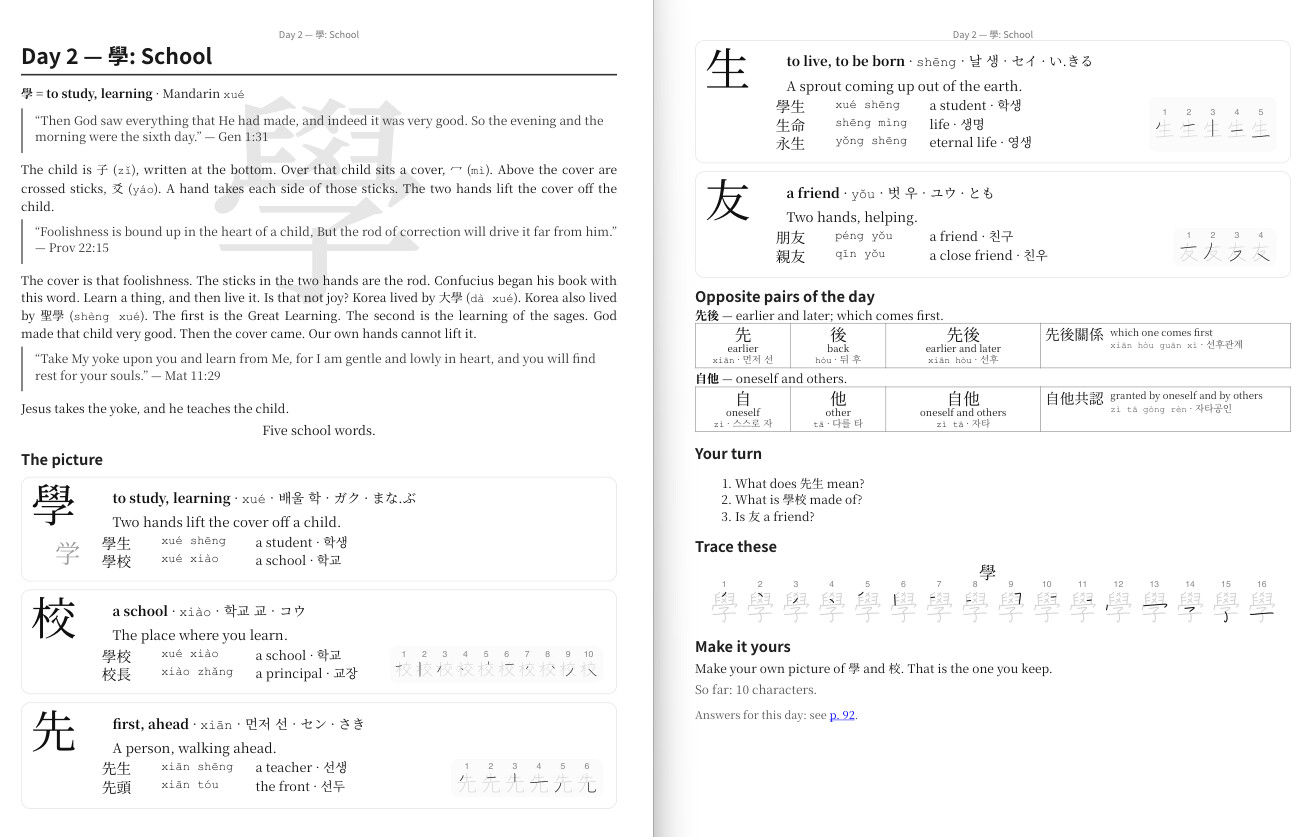
Day 2 of Volume 1. 學 is a child, 子, under a cover, with two hands lifting it off—and Genesis 1:31, Proverbs 22:15 and Matthew 11:29 standing beside the strokes.
The 學 page does the work I hoped for. God saw everything He had made, and indeed it was very good (Genesis 1:31). Foolishness is bound up in the heart of a child (Proverbs 22:15). The cover inside the character is that foolishness, and our own hands cannot lift it; then Matthew 11:29, take My yoke upon you and learn from Me, and one line under it: Jesus takes the yoke, and He teaches the child.
Ten minutes. Five characters. That is the whole day.
Volume 2 — the story
One character a day through Genesis 1–11, and one four-character saying told as the story it is: 塞翁之馬, the old man at the border, the horse that ran away, the horse that came home, the broken leg, the war.
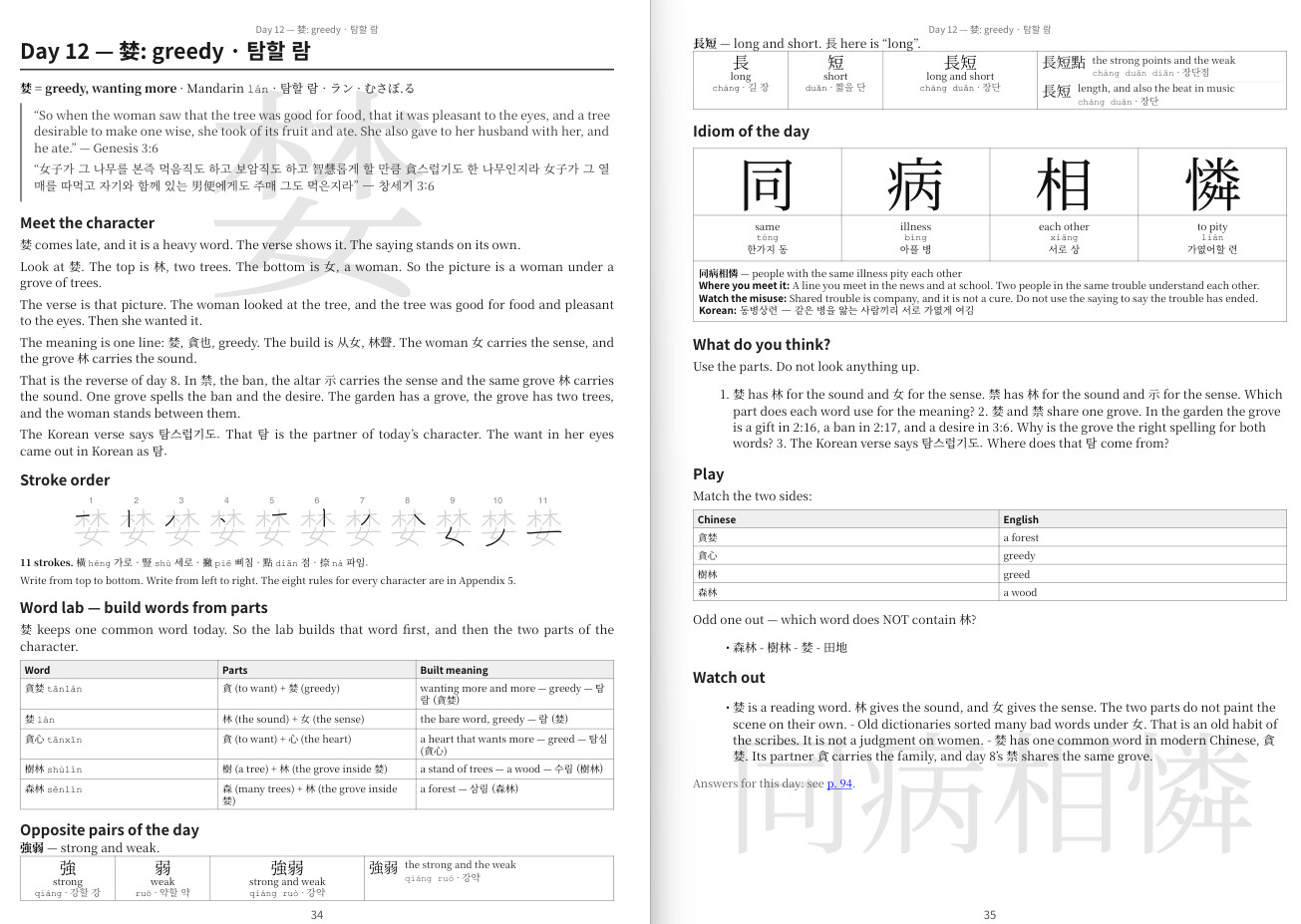
Day 12 of Volume 2. 婪 is 林, a grove, over 女, a woman: Genesis 3:6 in one character. The same grove spells 禁, the ban, four days earlier.
婪 is greedy, wanting: a grove above, a woman below, the woman of Genesis 3:6 standing under the trees looking at what she was told not to take. The same 林 carries 禁, the ban, on day 8—one grove spells the command and the craving. And in the margin, a note that the old dictionaries filed many bad words under the woman radical: a habit of the scribes, not a verdict on women. That kind of care is on every page.
One character, three countries
The Chinese volumes were the hard ones. A character is not one thing: 學 is 학 in Seoul, がく in Tokyo, xué in Beijing, and the mainland writes 学. Print the wrong form and you have handed a Korean child a character he cannot find in the book he already owns.
So the page prints the traditional form, the one Korea and Taiwan kept, with the simplified form in grey underneath where the mainland differs. It gives the pinyin with the tone, the Korean reading, and one Japanese on and one kun. Hanja, kanji, hanzi: one writing system, four scripts, and a child standing in the middle of all of them. Getting that right took longer than any Greek or Latin page I have written. I would not have published these two at all if I could not make them compelling as well as correct.
The collection
The third book puts all four languages in one volume. Five courses of thirty-one days—Hebrew, Greek, Latin, and the two Chinese parts—412 pages, a verse in front of every lesson, published by Maranatha Harpazo. It is the student edition: no questions, no answer keys, only the lessons and the appendices. Hebrew comes first, because the Bible opens in Hebrew.
And it does one thing the separate volumes cannot. The lesson ends not with questions but with Related days in other sections—the day, its title, the page. Meet 心 as the Latin cord on day L-17, and the page sends you to the Greek cardi day, the Hebrew lev day, and the Chinese day where 心 is a card. One idea, four languages, cross-referenced at the foot of the lesson—that is what the one volume is for.
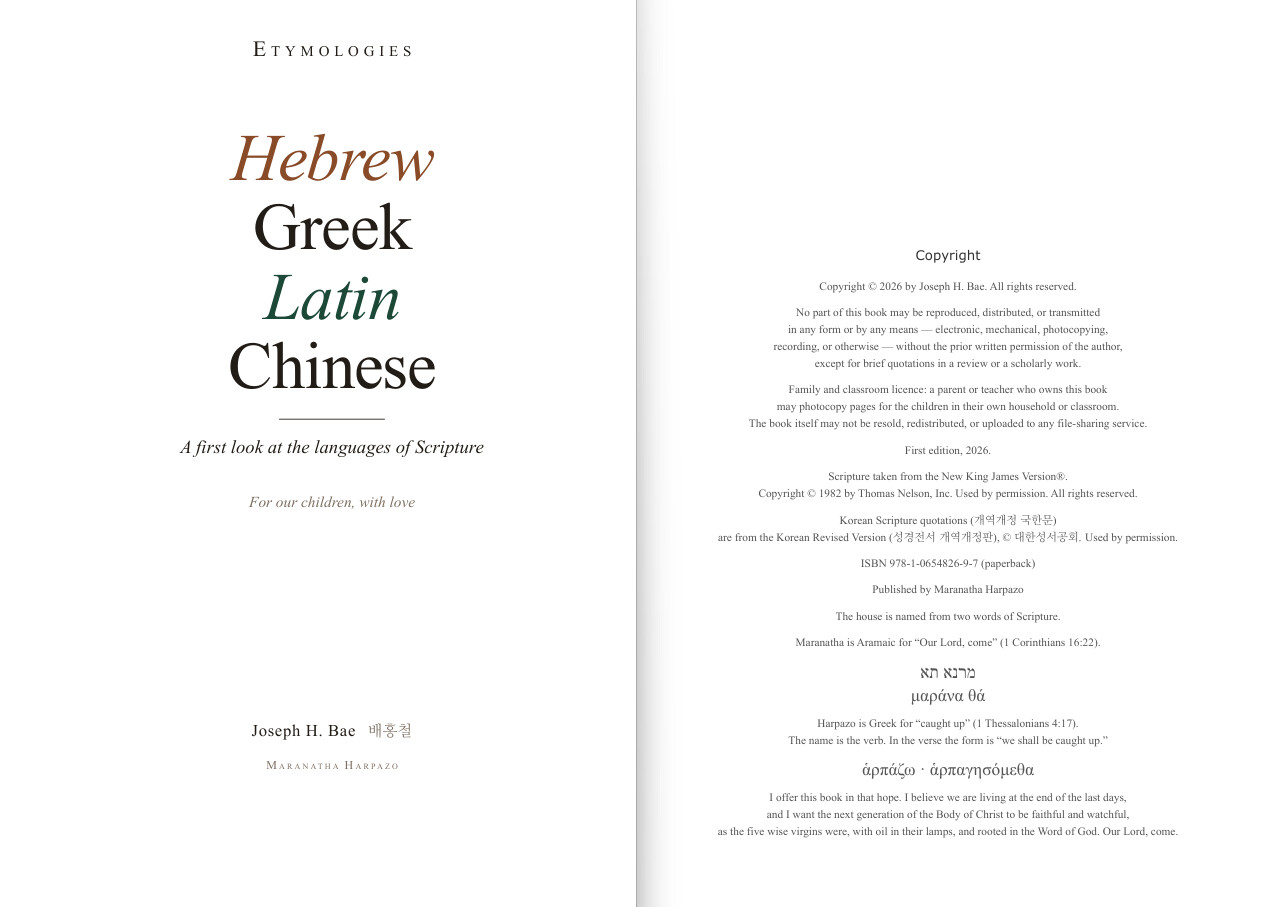
The title page. Four languages, four colours, one hand—and on the facing page, the reason the press is called Maranatha Harpazo.
The arithmetic
I priced these the only way I could justify, and the numbers say something worth saying out loud.
Volume 1 is 96 pages and sells at £7.99. Volume 2 is 100 pages at £7.99. The collection is 412 pages at £14.99. Five times the lessons of either Chinese volume, for less than twice the price—155 lessons against 31, 412 pages against 96, and every appendix in the book besides—because a thin book still carries a cover, an ISBN and a setup, and printing is charged by the page while the price has to carry all of it. The two Chinese volumes together cost £15.98. The one volume that holds both of them, and three more courses on top, costs 99p less.
The Kindle is $5.99 / £3.99 / €4.49, and it is the bargain of the lot, because there is no paper in it at all. If money is tight in your house this month: buy the Kindle, or buy the one volume and skip the paperbacks for all five volumes—Greek, Latin, Hebrew, and the two Chinese ones. The lessons are the same, and the answer keys are not the point of any of it.
The Korean edition, 『어원들』 (978-1-0654826-3-5), cannot go on Amazon at all—KDP will not print Korean. It goes through IngramSpark instead, whose printing costs are materially higher than Amazon’s, which is why that one is £24.99 rather than £14.99. It is still in review. When the road opens, it will be announced here, the way Bible Promises did it.
Six years ago
The Hebrew came out of one summer. Joshua was seven. We sat at home in the pandemic and set out to memorise all 176 verses of Psalm 119 in Korean—twenty-two stanzas of eight verses, one stanza for each letter of the Hebrew alphabet, alef to tav. By the time we could recite the psalm, we had memorised the alphabet it is built on, and I had fallen in love with the languages God actually used.
Six years later: five courses, four languages, and one book on a bench outside a shop.
“Oh, how I love Your law! It is my meditation all the day. You, through Your commandments, make me wiser than my enemies, for they are ever with me. I have more understanding than all my teachers, for Your testimonies are my meditation. I understand more than the ancients, because I keep Your precepts.”
Psalm 119:97–100 (NKJV)
The psalm has made me wiser than all my teachers. That is not modesty and it is not a boast. It is the plain report of six years of one chapter, recited in the car and at the table, until it was not a text I knew but a text that knew me.
Every day of these books opens on a verse, chosen the way it was in the first three volumes. A book about words must not teach a child that words come first.
I believe we are living at the end of the last days. I want the next generation of the Body of Christ found faithful and watchful, like the five wise virgins, with oil in their lamps—and the oil real.
Maranatha.