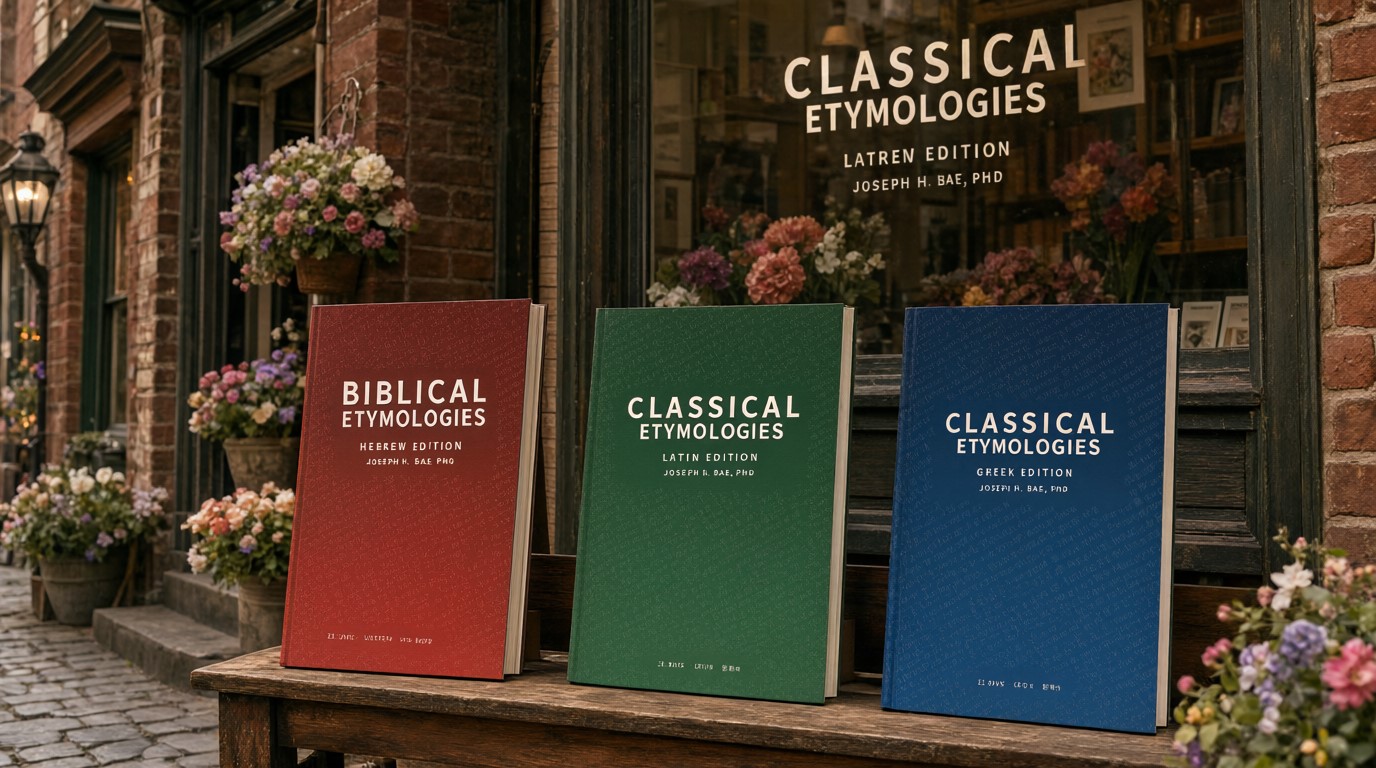
📚 I Published Three Books
I published three books in quick succession.
My first three commercial books ever, with my name on the cover. (Not counting my doctorate dissertation.)
Earlier this year I built three typing games. Now, three books. They say buses come in threes. I did not plan a convoy — I planned one booklet for my own children during a long summer, and the thing multiplied.
Classical Etymologies — Greek
Thirty-one Greek roots, one a day. Each day takes a root like bio or chron, builds real English words out of it with the child’s own hands, and then matches it to the Korean 한자어 that carries the same idea.
Classical Etymologies — Latin
The same treatment for thirty-one Latin roots — vid, scrib, dict, duc, fac, ven, spect — plus the phrases still printed on our walls: veni, vidi, vici; vox populi; status quo; facta non verba. It also explains why September is not the seventh month, which no one has ever asked me but everyone should.
Biblical Etymologies — Hebrew
Thirty-one Hebrew roots from the Old Testament, taught the way Hebrew actually works: three consonants first, then the vowels and the little bits that change the job, then the whole family of words sharing that skeleton — bara, mayim, ruach, qadosh, shalom, shema, yasha, bayit.
How They Started
Not with a business plan. With two sets of children on two continents.
My own children are in secondary school here in the United Kingdom. Their English is strong; their Korean gets weaker every year. My nephews and nieces moved to California, where they attend a Classical Academy — Latin, Greek roots, the classical bones of English — and they already know a good deal of Hanja.
I watched both sets of children and thought: what if we joined the dots? A Greek root on one side, the 한자어 with the same meaning on the other, and the child suddenly sees one word-building system doing its work in two languages at once. Hospital signs a child walks past every week stop being a wall of syllables and become readable.
That became the Greek volume, and then the Latin one beside it. Thirty-one days, one root and one verse a day: small enough to finish, big enough to matter.
The Hebrew One Came From Somewhere Else
During the pandemic I sat at home with my then seven-year-old son, Joshua (준수), and we set ourselves a strange piece of work: memorising all 176 verses of Psalm 119 — in Korean. Twenty-two stanzas of eight verses each. Twenty-two, because the psalm is an acrostic and the Hebrew alphabet has twenty-two letters, one stanza per letter, alef to tav. By the time we could recite the psalm, we had memorised the entire 22-letter alef-bet that it is built on. So began my personal passion and hobby of biblical Hebrew words (roots).
This Hebrew book is hopefully a beginning. Same shape as the Classical Etymologies books — one root a day, one verse a day — but this time the roots are the ones the Old Testament itself is built on. This is personally the book I’m most excited about: I’ve been looking for a book like this myself, but haven’t found one. So I made it myself. Thank You, Jesus!
The Rule I Would Not Break
Every day in these books opens with Scripture, and the verses were chosen by a rule I refused to bend: Psalm 119 first, wherever a real match existed; another psalm or a proverb if not; the rest of the Bible only when the match was exact. Not decoration. The fear of the Lᴏʀᴅ is the beginning of knowledge, and I did not want a book about words to teach my children that words come first.
Soli Deo Gloria.
One More Thing
The Korean editions of all three volumes are written and typeset, but Amazon’s self-publishing arm does not accept Korean as a language, so they are not going up there. I am working out the right way to get them into Korean-speaking homes, and when I do, it will be announced here.