🇯🇵 Japan's Secret
The scoreline was 2–2. But nobody remembers the scoreline.
On 14 June, Japan played Netherlands at Dallas Stadium in Arlington, Texas. It was a thrilling match — Japan playing this breathtaking “total football” style that had everyone on the edge of their seat. An observer noted:
There’s something unusual about this team. When they defend, it feels like all 11 players are defenders. When they attack, it feels like all 11 players are attackers. The same applies in midfield. They’re organised in a way that would terrify any opponent, and the understanding between the players is incredible.
Beautiful football. The kind of performance that makes you think Japan’s going to do something special at the World Cup.
But the real story wasn’t the match.
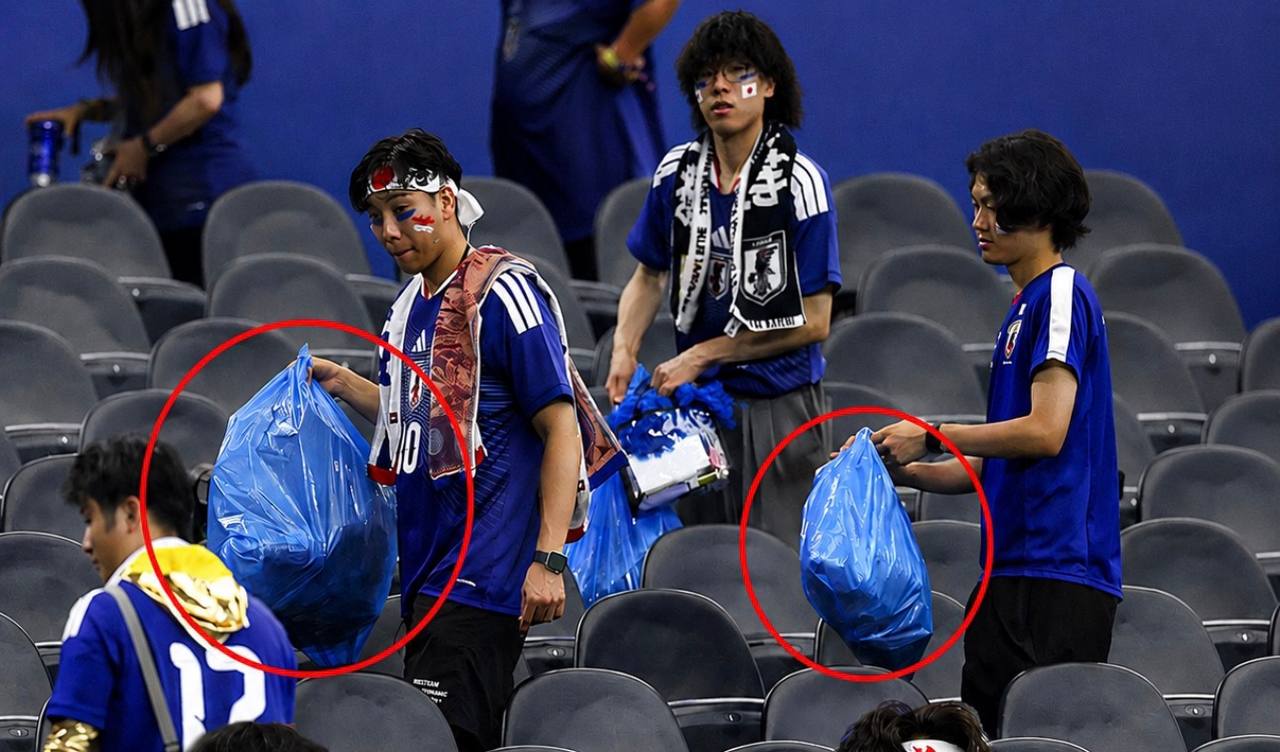
When the final whistle blew and the crowds began to leave, something remarkable happened. Every single Japan fan pulled out their blue plastic bags — the same ones they’d been waving throughout the match to cheer their team — and started collecting litter. The stands were spotless when the last fan walked out.
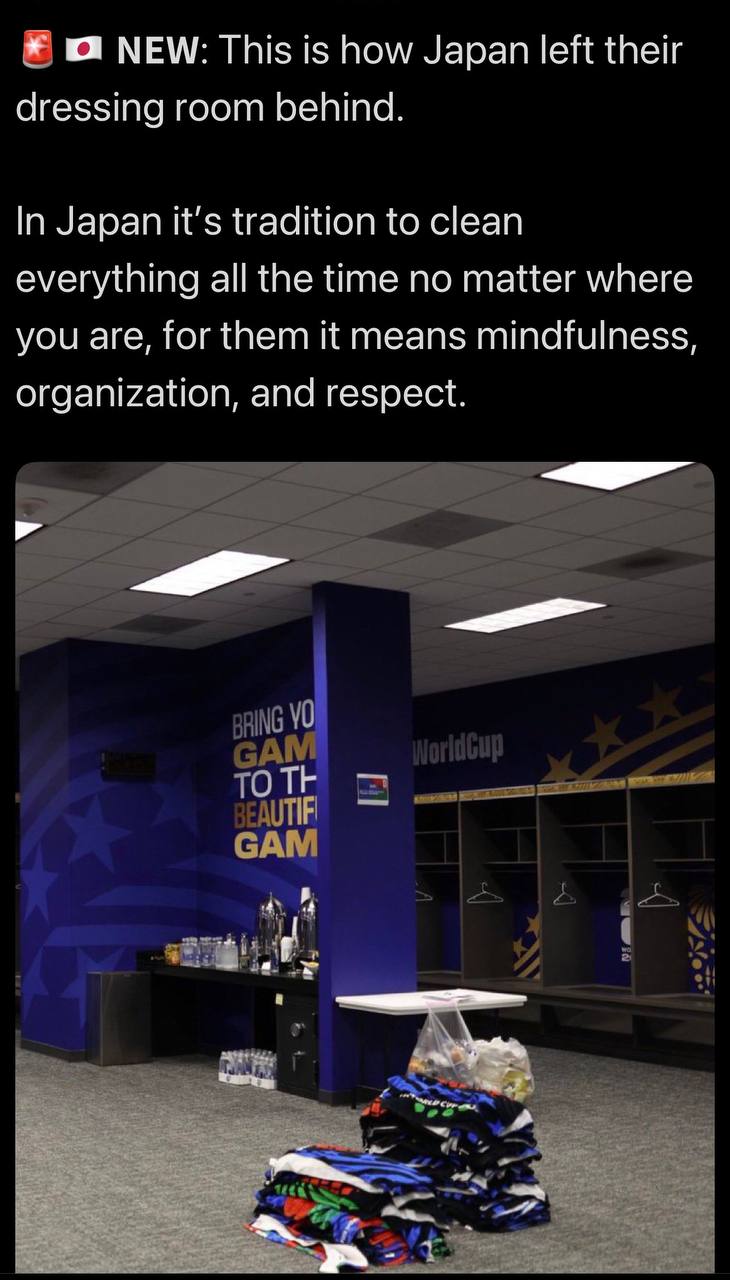
And it didn’t stop there. Reports came out that the Japanese players left their locker room in “a cleaner state” than they’d found it.
The world watched and was stunned. Social media exploded. People couldn’t believe what they were seeing.
Not all cultures are the same. Some are clearly superior. ❤️🇯🇵
A friend from Japan put it perfectly: “Haha yeah, this is Japanese culture and pride lol. Leave it in a better condition than when you arrived.”
That sentence — “leave it in a better condition than when you arrived” — has been haunting me.
Years ago, being the Japanophile that I am, I went down a rabbit hole trying to understand why Japanese culture produces this kind of behaviour. What you drill into a society’s children that makes them naturally clean up after themselves? What moral framework produces people who, without any authority telling them to, pick up other people’s rubbish?
My findings were surprising. And they ended in Jesus, in a way I didn’t expect.
The Silver Rule
What Japanese children get drilled on from kindergarten is a deceptively simple principle: do not do unto others what you would not have them do unto you.
Or put differently: don’t inconvenience others. Don’t impose yourself on others.
Think about it. You wouldn’t want strangers trashing your home, so you don’t trash a public space. You wouldn’t want people leaving messes in your office, so you leave the locker room cleaner than you found it. It’s basic empathy — but the Japanese institutionalise it from the age of four.
This principle has a name: the Silver Rule. And it is not uniquely Japanese. It appears across every major civilisation.
The Confucian version: “Do not impose on others what you yourself do not desire.”
The Jewish version: “What is hateful to you, do not do to your neighbour.” (Hillel)
The Hindu version: “This is the sum of duty: do not do to others what would cause pain if done to you.”
Every major moral tradition has stumbled upon this negative formulation. Don’t harm. Don’t inconvenience. Don’t impose. It’s the floor of human ethics — the baseline beneath which a society collapses.
So why Japan? The silver rule is universal.
Japan doesn’t teach it better — it installs it better. Three mechanisms run at once that no other silver-rule culture combines.
One: it compresses the rule into a single daily imperative. Confucius, Hillel, and the Mahabharata left the silver rule as a proverb — something a society admires. Japan rendered it as an operating instruction: meiwaku wo kakenai — “don’t cause trouble” — the fundamental driving force from childhood. Not a maxim to recall, but a reflex to obey before you’ve finished forming the thought.
Two: it drills it as embodied habit, not precept. This is the decisive move. Through souji — daily school cleaning in small groups, with no janitors, rotated so everyone does every task — the rule is trained into muscle memory rather than lectured into conscience. Day after day, students reinforce the habit. You don’t believe the silver rule; you’ve swept it ten thousand times. Other cultures moralise; Japan rehearses.
Three: it backs it with both a social and a sacred enforcement layer — and the sacred one is the real differentiator. Socially, there’s seken no me, “the Eye of the World” — the centuries-old power of the surrounding society, the external-sanction engine Benedict labelled a “shame culture” versus the West’s “guilt culture.” But Korea and China are also Confucian shame-honour cultures with the silver rule — and they’re not Japan. What Japan has that they lack is Shinto purity. Before Tang influence, native Shinto already treated cleanliness as sacred: the gods favour purity and are repelled by defilement, and uncleanliness — kegare — is bound up with sin and misfortune. Disorder isn’t just rude; it’s a contaminating breach of harmony that must be ritually cleansed. So in Japan alone, “don’t inconvenience others” fuses with “don’t pollute.” Litter isn’t merely inconsiderate — it’s defilement. That gives the silver rule a quasi-religious motive force the purely Confucian neighbours never had.
One imperative, embodied not preached, enforced by both a watching society and a sense that mess is defilement. That stack is why Japan tops every other silver-rule civilisation.
And yes, it can be stifling. The extreme version — never inconveniencing anyone, never imposing — can create a society where people are too polite to speak honestly, too careful to express themselves. My Japanese friend laughed about it, but there’s truth in the tension.
The Golden Rule
Here’s where Jesus comes in.
The Silver Rule has existed in every world religion for all of recorded history. It’s the default. The floor. The negative command: don’t harm.
Jesus was the first person in human history to teach the positive version:
And just as you want others to treat you, treat them in the same way. (Luke 6:31, NIV)
So in everything, do to others what you would have them do to you. (Matthew 7:12, NIV)
This is the Golden Rule. Not don’t harm — actively do good. Not don’t trash the stadium — clean it. Not don’t inconvenience me — serve me.
The Silver Rule is about restraint. The Golden Rule is about love.
The Silver Rule says: don’t be a problem. The Golden Rule says: be a gift.
The difference is everything. It is not a marginal upgrade from negative to positive. It is an entirely new category of ethical teaching. One says: keep your hands to yourself. The other says: use your hands to build.
No one in the history of the world taught this before Jesus. Not Confucius. Not Hillel. Not the Buddha. Not Socrates. The Silver Rule is ancient and universal. The Golden Rule is new. It arrives in one place, at one time, from one person.
And I would say: I would not expect anything less. If the Creator of the universe steps into His creation, it is entirely congruent that He would give humanity an entirely new concept of ethics. Why would He just repeat what every civilisation already knew? He came to surpass. To elevate. To show us what love actually looks like when it’s not just restraint but generosity.
Not Just Taught. Lived.
Jesus didn’t just teach the Golden Rule. He lived it.
Not just don’t harm. He absorbed the harm. Not just serve. He served. Not just be a gift. He was the gift.
He took a broken, filthy, sin-strewn world and offered to leave it spotless. He became the ultimate Solution — not the Silver Rule with a slightly shinier finish, but the full, unadulterated, propitiation of the Creator dying for His creation.
And He didn’t just die. He rose. The Resurrection — the historical evidence for which is, frankly, overwhelming — was the receipt. The universe’s way of saying: paid in full.
That’s what the Creator does. That’s what love looks like.
Maranatha. Come, Lord Jesus.