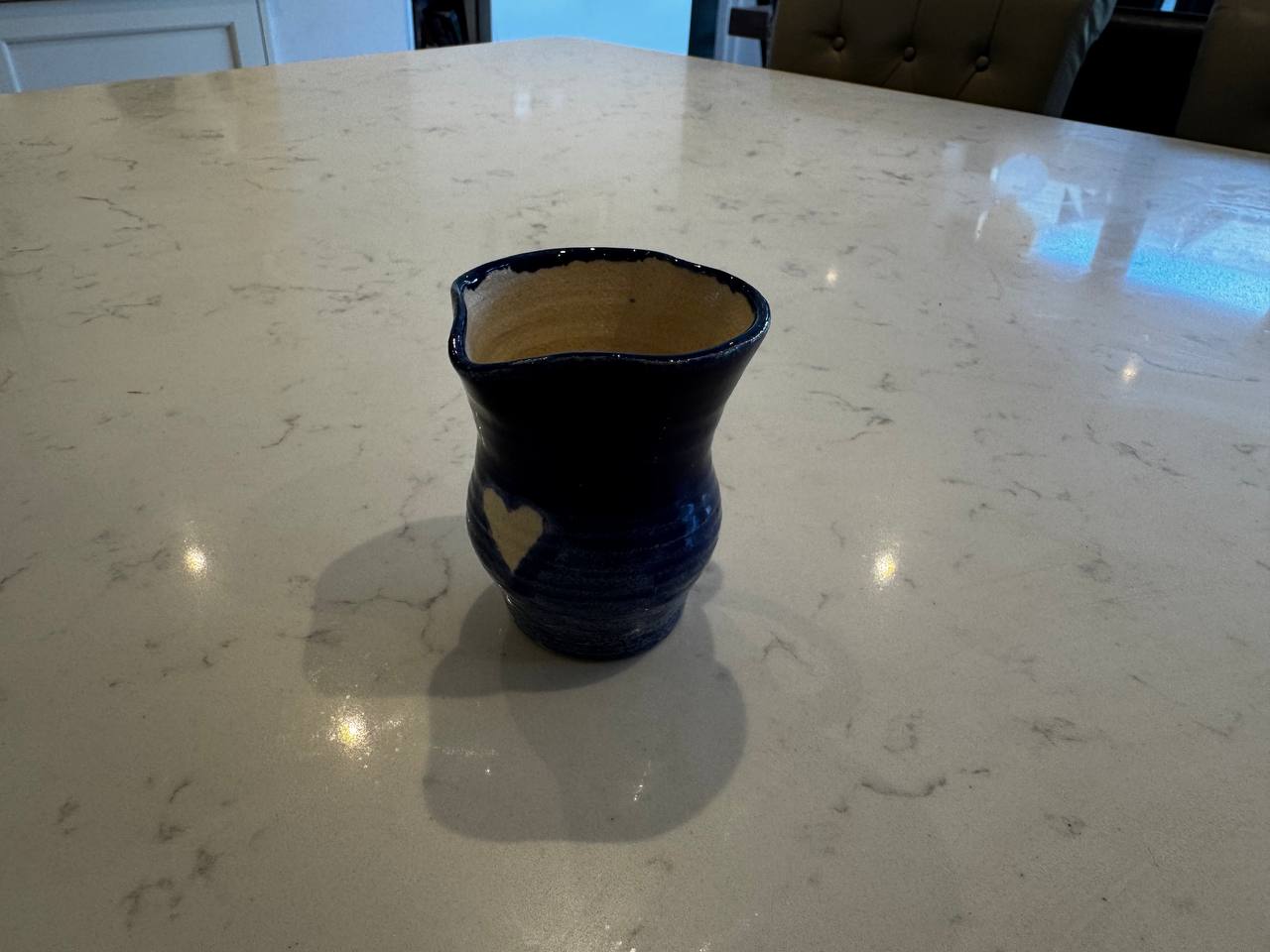
🫖 The Milk Jug
I have a small ceramic milk jug sitting on my kitchen counter. Navy blue, hand-thrown pottery, with a little white heart stamped on the side. It holds just enough milk for a splash in a cup of tea — nothing more.
By any objective measure, it is an unremarkable object.
And yet I treat it like an heirloom.
Every time I use it, I wash it by hand. I dry it by hand. I set it back carefully in its place. I wouldn’t dream of tossing it in the dishwasher. I’ve never once left it sitting in the sink to soak overnight with the mugs.
Why? Because I remember exactly when I bought it, exactly where I bought it, and exactly how much I paid: £10. For a tiny milk jug.
That is, by most people’s reckoning, absurd. You can pick up a perfectly serviceable plastic one for under a pound. But I stood there, turned it over in my hands, felt its weight, looked at that small white heart, and made a conscious decision. I paid a price that cost me something. And because it cost me something, it matters to me. It has weight — not just physical weight. Moral weight.
The Price Determines the Value
We have known this instinctively since childhood. The gift you saved up weeks for means more than the one you grabbed without thinking. The house you stretched your budget for, the car you worked overtime to afford — these are not just objects. They carry the story of what you sacrificed to possess them.
Conversely, what costs us nothing tends to mean nothing. Paying the full price — committing fully, rather than hovering indefinitely in the comfortable shallows — is what transforms passive interest into genuine ownership.
I didn’t stumble into that jug. I chose it. I paid for it. And so I take care of it.
Bought With a Price
This is not ultimately a story about crockery.
“For you were bought at a price; therefore glorify God in your body and in your spirit, which are God’s.”
1 Corinthians 6:20 (NKJV)
Paul says it plainly: you were bought. Not rescued as an afterthought. Not appreciated in some vague, sentimental sense. Purchased. At a price.
What price?
The life of the Son of God.
This is the doctrine of propitiation — not merely that Jesus died, but that He bore the full weight of divine wrath that our sin had accumulated, and absorbed it entirely in His body on the Cross. It cost Him everything. There was nothing left to spend. The transaction was total and irreversible.
And here is what strikes me every time I pick up that little milk jug: when something costs you everything, you take care of it.
I hand-wash a ceramic jug because I remember the £10. How much more will God guard what cost Him His own Son?
He Will Take Care of You
I am aware that the times are difficult. The storm that has been gathering for years is now clearly visible on the horizon. Geopolitical instability. Economic pressure. The slow crumbling of institutions we once trusted. A culture in open rebellion against the God who made it.
It would be easy to despair.
But consider this: you are not an item God picked up carelessly. You were bought at a price — the highest price ever paid in the history of the universe. The blood of the Lᴏʀᴅ Jesus Christ is the currency of your redemption.
Do you think He will now forget you?
“He who did not spare His own Son, but delivered Him up for us all, how shall He not with Him also freely give us all things?”
Romans 8:32 (NKJV)
Paul’s logic is airtight: if God already gave the hardest thing — His Son — what possible grounds do we have for doubting He will provide everything else we need?
A Mighty Shepherd
“The Lᴏʀᴅ is my shepherd; I shall not want.”
Psalm 23:1 (NKJV)
The Shepherd of Psalm 23 is not a figure of pastoral tranquillity only. He is the same God who parted the Red Sea. Who appeared in the burning bush. Who led His people through the wilderness and did not lose a single one He had promised to bring through. He leads through valleys — dark valleys — and He has not lost a single sheep He paid for.
He is able to deliver you. He is willing to deliver you. And He cares about you — not in some cold, theological-formula way, but with the fierce, personal investment of One who looked at the cost and said: worth it.
More than I care about my little navy milk jug. Infinitely more.
So let that be your anchor as the storm rolls in. You were bought at a price. The One who bought you does not abandon what He has purchased.
He’s got this.