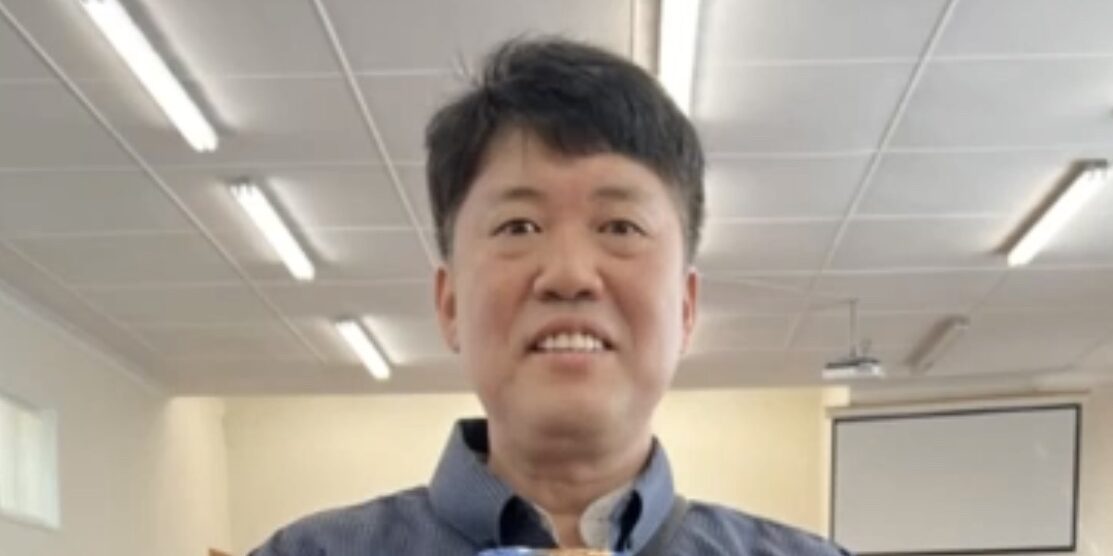
🎤 From Shamanism to the Cross: Pastor Han’s Testimony
A note before we begin: I’m sharing this story with the full permission of the man who lived it. Pastor Han Seong-mo joined our “Kindling of Revival” prayer team during the 2023 Wales Prayer Mission, and what he shared with us was too important to keep in that room. This is his life—told in his own voice.
—-

God’s Astonishing Plan for One Life
From Shamanism and Humanism into the Gospel of the Cross
Han Seong-mo — Senior Pastor, Daejeon Han-Sarang Church
—-
Called to Preach Before I Could Even Stay Alive
I was born in a rural village in Chuncheon, Gangwon Province. My father lost both his parents during the Korean War and grew up in real poverty. He came to faith because someone told him that if you believe in Jesus, your whole family will eat. That was enough for him. He married my mother, who was from Tongyeong, and together they scraped by. I came into the world as their second child—born into one of the hardest seasons of their lives.
My mother didn’t even know she was pregnant with me until four months along. At seven months there were signs of miscarriage. I arrived at eight months, a premature baby—nothing but bones. My parents didn’t expect me to survive.
I started putting on weight once I began nursing, and for a while things seemed alright. But around age two or three, tuberculosis complications set in. Every day I was coughing, wheezing, unable to breathe properly, my nose running constantly. My mother would strap me to her back and ride the bus an hour to the hospital, weeping the whole way. Then came the day the doctors said I needed three months of inpatient care. My parents braced themselves for the worst.
The church was in the middle of a revival at the time. The whole congregation prayed for me. Nine days later, I was discharged.
My parents made a vow: If you spare his life, we’ll give him to You, Lord. Whether it was that vow or something God had already decided before I drew my first breath, I cannot say—but from my earliest memories, I wanted to be a pastor. That dream never wavered. Every camp, every revival meeting, every time a speaker called people forward into ministry, I knew the invitation was for me.
Learning to Follow God Inside the Church Walls
When I was eight, my father became a caretaker deacon at a Methodist church in Seoul, near Namsan. That’s when my real formation began. Living inside the church meant attending everything—Sunday morning and evening services, Wednesday prayer meeting, Friday night prayer, retreats, revivals. I was immersed in the church during the great revival decade of Korean Christianity in the 1980s.
By middle school I received the gift of tongues during a revival meeting. In high school, at a retreat, I heard God’s voice—clear and personal:
“I can do all things through Christ who strengthens me.”
Philippians 4:13 (NKJV)
That word landed in me like a foundation stone. Nothing about the path seemed impossible. Nothing stood in the way of the call.
Seminary: Where the Water Was Liberal and the Wine Was Doubt
Because my church was Methodist, I enrolled at Methodist Theological University—the closest seminary in our denomination. I entered at a charged historical moment. I had watched the 1987 democratic uprising from close range. University students fleeing riot police had actually taken shelter in our church. My father had hidden some of them. On the streets near Namdaemun, I’d seen crowds filling the road all the way to Seoul Station, singing the national anthem. That was the atmosphere I brought into seminary.
What I found there wasn’t what I expected. The student council, the theology and education and religious philosophy departments—all of them were swept up in progressive politics. A small group of non-mainstream intercessors prayed at lunchtime for Korea and the nations, but they were the minority. The dominant culture favored philosophical reflection over prayer, progressive ideology over Scripture. Alcohol and cigarettes were practically rites of passage.
And then there were the professors. One had returned from Germany with religious pluralism as his theological framework, teaching systematic theology through that lens. His student, another professor, championed postmodern theology, wrote books supporting the historical Jesus movement, and eventually both were expelled from the denomination. Rather than settle my convictions, their expulsion made me curious: Why were they kicked out? So I read their books. I attended their seminars. I went to interfaith dialogue events at Anglican cathedrals. I sat in on graduate seminars as a first-year undergraduate, trying to understand what they were saying.
From there it was a short slide into the folk percussion troupe, where traditional culture study came packaged with Juche ideology. I told myself I was a reformist theologian transcending the old faith, and I looked down on the people who were just praying and weeping in the pews. A professor who’d studied in Germany introduced me to progressive alternative education movements, and I found myself in dialogue with people at a Buddhist environmental center in Insadong. Curiosity pulled me deeper and deeper into liberal and progressive theology until I didn’t notice anymore that my entire life had drifted off course.
The Enlightened Pastor—A Posture, Not a Reality
Naturally, I came to think of ministry as activism. Environmental advocacy, human rights work, women’s liberation, community organizing, alternative education—I believed that a pastor who was truly awake to the age had to be doing all of this. Praying and studying the Word in a church building seemed small compared to growing organic vegetables in the countryside as a voice for ecological justice. Being able to drink makgeolli with farmers in a remote village meant you were relational. Getting along with people of other religions made you sophisticated.
The Methodist denomination had a program called “Settled Ministry Training” that embedded you in rural ministry under older pastors who’d walked this activist road. I followed them. I visited Buddhist temples, Catholic retreat houses, contemplative monasteries. I learned something called the Enneagram—actually an esoteric tool traced back to Sufi mystics—from a Catholic priest. I participated in a practice called “Family Constellations,” a therapy method rooted in shamanic healing traditions filtered through Jungian psychology. I called all of this spiritual formation. I had no idea what I was actually doing.
I was embodying religious pluralism and postmodernism with my body, not just my ideas. What I dressed up as spiritual discipline was, at its core, a pursuit of self-satisfaction and an occasion for pride. The whole thing was built on human effort, on the idol of self-constructed values. God was spoken of vaguely, pantheistically—a concept, not a Person. There was no actual relationship. No submission to His sovereignty. No encounter.
The Cracks Appear
The senior pastors I looked up to—the ones who flew the banners of love, freedom, and justice—turned out to be men who were generous with themselves and indifferent to their wives. They belittled their families. I started to mirror that. My internal anger and sense of superiority made it hard to sustain friendships. I judged everyone around me while performing my own righteousness.
The conviction that I had chosen the right road—and that it must therefore be right—began to crumble like a sandcastle. But I couldn’t leave the community I’d built around those values. The warmth and social capital and sense of belonging kept me anchored in place, even as the foundation rotted beneath me.
The Turning Point: A Failed Mission and a Wrecked Life
Four years into rural ministry, I had been ordained but had no idea what I was actually doing. My wife was threatening divorce. Rather than face the real questions, I took a position as an associate pastor at a large Seoul church—a way to protect my dignity, on the surface at least, while keeping peace at home.
But I had no clarity about why God had placed me there, and that confusion made everything worse. Then a senior missionary I knew called me from China to join his youth ministry there. I said yes—mostly because it meant escaping a situation I hated. Our whole family packed our bags and went with high hopes.
The first day we arrived, the environment was nothing like what had been promised. We were put in the wrong place, told we needed to suffer a bit. Then, when conflicts began within the ministry, we were blamed—accused of splitting the church. The missionary reported back to Methodist headquarters in Korea that this young troublemaker had destroyed everything. My wife and I cried until there was nothing left.
When we returned to Korea I could barely breathe just thinking about it. My mother introduced me to a small Presbyterian church in Incheon. And that’s where I decided: I’m going to settle this once and for all. Does God actually call me or not? I am not moving one step until I have a clear answer.
The Gospel of the Cross Opens Everything
At that small church in Incheon, I heard the gospel of the cross.
I had known these words since childhood. I knew the Bible passages. But this time the words weren’t ink on a page—they arrived as living truth. The love of Jesus Christ poured out on the cross reached me in a way I had never experienced before. And in that light, I saw clearly for the first time how completely my years of ministry conviction had been built on sand.
Through the intercessors at that church, I also heard something I desperately needed to hear. A word came: God called you from before the foundation of the world. He has not changed His mind. He still loves you deeply.
That broke me. I repented of everything—every root of sin, every rotten fruit of the life I’d built, every proud posture, every judgment, every compromise. I decided to live only as He led me.
The people I had spent years criticizing—pastors I had scorned, churches I had mocked—I began to see through different eyes. The one who had wronged us so badly in China—I began to intercede for him. The most humiliating season of my life became, in that light, the most necessary season of my life.
I cut off the friendships and networks built around my old theology. I chose to hold loosely the relationships God was now bringing and let Him determine what would last.
“being confident of this very thing, that He who has begun a good work in you will complete it until the day of Jesus Christ”
Philippians 1:6 (NKJV)
Fifteen Years Later
Fifteen years have passed since that turning point. I still fall. Temptations still come, and I don’t always handle them well. But I am no longer the one holding myself up. The One who began a good work in me will carry it through—and that confidence is the only reason I can keep getting back up after every fall.
To Him alone be the glory. Praise the Lord!
—-
Update: this testimony was shared during the 2023 Wales Prayer Mission — full report here.