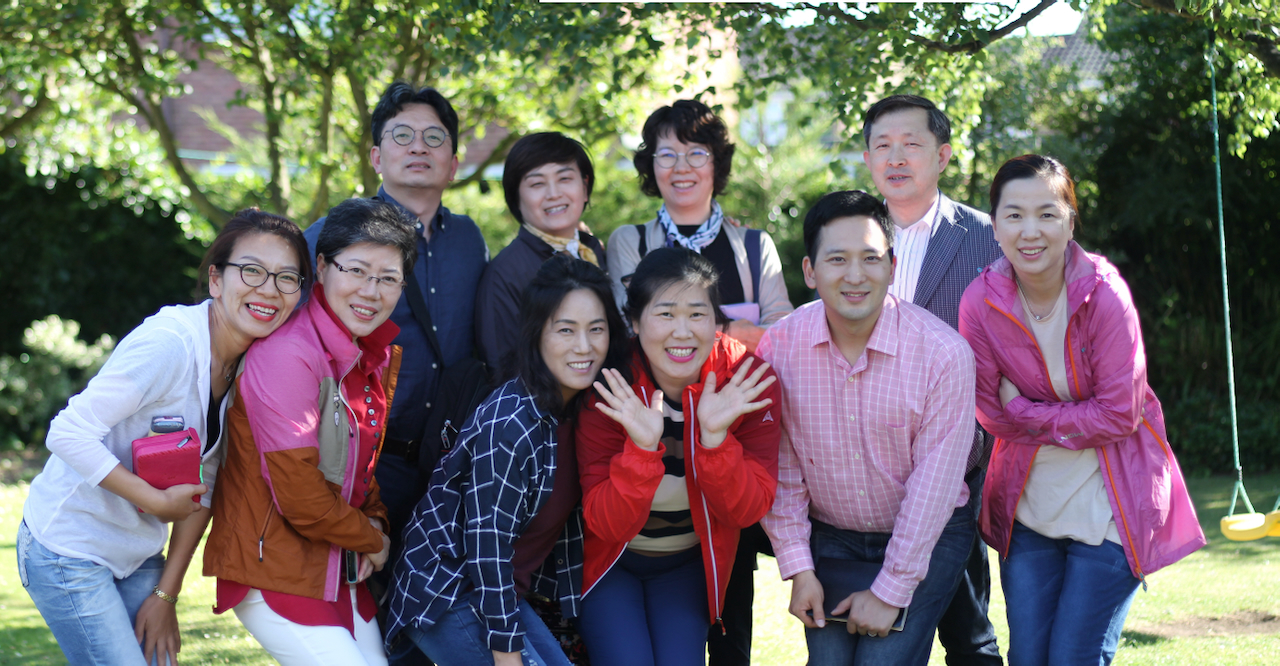
🙏 2017 Prayer Mission in Luton
From Monday 26th June to Sunday 2nd July 2017 in Luton, UK
📣 Introduction
In June 2017, I served as an interpreter at the 6th UK Prayer Mission in 2017 and felt compelled to jot down my reflections. (Update: six years later, I went again — this time to Wales — 2023 Wales Prayer Mission.)
Just a month or two earlier, I knew nothing about this sort of ministry and faced tough choices before committing fully. In April, I’d taken three weeks’ annual leave to host my parents visiting from Paraguay, leaving me with little left. It wasn’t easy to take another week off for the prayer mission, especially with our limited family time.
Yet the main reason I wanted to join was to revive the faith of my youth. Living and working in the UK while raising a young family, I’d struggled to keep a faith uncompromised by the world. I longed to reclaim the godly passion and pure prayer life from my university days — something I’ve reflected on since, like in my piece on the health of your spirit.
I hoped this focused intercession for the UK would reset my walk with God. Looking back, I’m deeply grateful that He gave me far more than I’d hoped for.
🗓️ Week Itinerary
On Monday evening, I headed to Heathrow Airport to meet Rev. Kim Nam-jin, who oversees the UK Prayer Mission, and Pastor Joe Pienaar, senior pastor of St. Hugh’s Church in Luton. He’d come to collect the intercessor team.
Soon after, we welcomed nine prayer warriors from Korea, led by Pastor Kim Moon-su. We boarded Pastor Joe’s rented 16-seater minibus and arrived at St. Hugh’s Church in Luton, where we’d stay, sleep, and pray for the week.
On arrival, we entered the sanctuary first to pray, dedicating the week to God and seeking protection for our families back home, before settling in for the night. I remember standing there in that empty church and feeling the weight of what we were about to do.
From Tuesday, mornings involved visiting sites around Luton for special prayer meetings organised by local churches with Pastor Joe’s help. The rhythm became familiar — British hosts would share their ministries and prayer needs, then Pastors Kim Moon-su and Han Sang-gyu would lead Spirit-guided corporate prayer. Each time I listened to those prayers, I learned something new about what intercession sounds like when it’s not going through an interpreter.
Seven days. One city. One cry.
These are the venues we visited each day:
- Tuesday: various Christian charities in Luton, including Azalea;
- Wednesday: an inter-denominational prayer meeting for Luton’s diverse nations;
- Thursday: an inter-denominational prayer meeting for Luton’s church leaders;
- Friday: a morning prayer meeting for the Luton Evangelism and Healing team, followed by an evening prayer session for youth ministry in the town centre (at Youthscape);
- Saturday: street evangelism;
- Sunday: morning worship at St Hugh’s, followed by a final evening intercessory service open to all Luton churches.
But the heartbeat of the week was the nightly prayer sessions from 10 p.m. to 2 a.m. — known as “pulpit prayers.”
We’d planned to rest on Saturday night, but the Holy Spirit stirred us to pray more. At 10 p.m., we gathered in the sanctuary and knelt as usual. Though tired and intending to finish by midnight, we prayed until dawn at 5 a.m.
Intense spiritual warfare marked the night, but from 4 a.m., we felt the joy of God’s victory. The sharing from 5 a.m. was a blessed time of mutual encouragement.
Some nights you pray and feel like you’re pushing a stone uphill. Saturday night, the stone rolled the other way.
🏘️ Introduction to Luton
A city the world wrote off. A city God hadn’t finished with.
Luton doesn’t evoke positive images in the UK. It’s seen as one of the poorest areas, linked mainly to its airport and budget airlines. I’d heard the reputation — what I hadn’t heard was the story of what happened when prayer arrived.
In recent years, a surge in immigrants has raised the Muslim population above 30%.
We also learned during the week that Luton lacks any standout secondary schools. Until 1966, Luton Grammar School was elite, producing leaders, but it closed and split into others.
This drives educated professionals to nearby towns like Harpenden for better schools, leaving Luton without skilled residents in a vicious cycle.
Yet there’s hope. In 2014, a Korean prayer team stayed at St. Hugh’s for a week, interceding with tears.
After they left, God moved: dark spiritual forces started to lift, and investments flowed in, redeveloping poorer areas.
For instance, the 2015 ThinkLuton initiative brought £1.5 billion initially. St. Hugh’s grew from 100 to over 250 members.
Most encouragingly, everyone we met said changes began post-2014 prayers. They valued prayer deeply and craved more.
I still recall Urika, who organised a meeting, saying: “Because prayer is the most important ministry!”
Standing in Luton, I finally understood: prayer isn’t a reaction to a city’s problems. It’s the thing that precedes the solution.
🛡️ Spiritual Warfare
The darkness didn’t know we were coming. But it knew when we arrived.
The week brought enemy attacks. Nightly pulpit prayers usually meant locked church doors for safety.
But on Wednesday, with St. Hugh’s members joining until midnight, we left them open. A demonised young woman entered and behaved oddly.
Team member Mrs. Kim noticed and began interceding at the back to confront the demons.
I tried approaching her, but she dodged around the pews and fled.
Next morning, we found countless strange objects she’d deposited throughout the sanctuary: small, black, irregular wooden balls, about 3mm across, hand-crafted—likely for curses.
We cleared the floor while praying, collecting enough to fill an empty water bottle one-eighth full.
Pastor Joe explained this woman, Estelle, had disrupted services, threatened violence, and prompted police calls.
Shockingly, Luton’s area around St. Hugh’s has deep ties to witchcraft and the occult.
Attacks persisted. Early Sunday morning, during our final prayers, we found demons hiding in praise flags behind the sanctuary.
This surfaced during prayers for the Pienaar family; Mrs. Jung saw the lead demon behind past attacks.
New to seeing demons, she panicked and struggled to breathe.
We surrounded her, waged warfare, and she soon recovered.
We marched the church, singing praises and praying in tongues. Mrs. Jung spotted the demon in the flags again.
Our pastors snapped each flag with their feet, expelling it in Jesus’ Name.
Once broken, the lingering discomfort vanished for many in the intercessory team.
I had never seen a demon before that week. I had never heard prayer that sounded like warfare — sharp, specific, unapologetically aggressive. By Sunday morning, I understood: the reason the world looks the way it does is not because God is absent. It’s because the battle has never been fought with enough persistence.
📖 Praying through the Word
You don’t pray the Word to get answers. You pray it because the answers are already in there.
As interpreter, I wanted to be a full prayer team member, not just a translator. I hoped my spiritual immaturity wouldn’t hinder them and that they’d see me as an equal intercessor.
God answered this. For two months, as youth leader in Ealing Korean Church, I’d memorised 5–6 spiritual Bible passages with the group.
I was grateful to meditate on and pray through them all week. Turning God’s promises into prayers brought immense power.
On the first vigil, I clung to Isaiah 40:31:
“But they who wait for the Lᴏʀᴅ shall renew their strength; they shall mount up with wings like eagles; they shall run and not be weary; they shall walk and not faint.”
Isaiah 40:31
Frankly, the long sessions exhausted me initially. While others grew energised, I kept checking my watch, stunned at time’s crawl.
I cried: “Father, why aren’t I renewed like an eagle despite waiting on You? You promised strength—give it now!”
Next day, God seemed to say: “Child, last night you flapped like a pigeon, relying on your strength, so you grew tired. Tonight, spread wings like an eagle and ride My love’s thermal.”
I was reminded of Galatians 4:6:
“And because you are sons, God has sent the Spirit of His Son into our hearts, crying, ‘Abba! Father!’”
Galatians 4:6
Clinging to it, I prayed: “Father, this morning Iranian Christian Hamina shared visions of open heavens, gold rings, Your anointing hand, angels filling quivers. Show me, as promised in Jeremiah 33:3!”
“Call to me and I will answer you, and will show you great and hidden things that you have not known.”
Jeremiah 33:3
I didn’t receive visions that week. Not one. But I saw something else: the reality of spiritual warfare with my own eyes. I understood a little more of God’s heart for Luton, for Britain, for every city that has been told it’s too far gone.
He doesn’t send visions to the curious. He sends them to the persistent. And I was just getting started.
—-
Humility and Gentleness
If I had to describe this entire week in two words, they would be: humility and gentleness.
First, the mission’s DNA. When Missionary Kim Nam-jin first explained this ministry to me, the three founding principles stopped me cold: humility, service, sacrifice. And the posture the Korean teams take when they go to British churches is not “let us show you how to pray properly.” It’s this: “The missionaries from your nation gave their lives to bring the gospel to our people. We are the fruit of that seed. We have come to pray for you as a small way of repaying that debt.” I watched British believers hear that explanation over and over in Luton, and every single time it landed—it softened people, opened them, made them receive us as brothers and sisters rather than as religious performers from abroad.
Second, Pastor Jo. This man drove a 16-seat minibus all week as our personal chauffeur. Every time we needed anything—water, fruit, bread, Korean rice—he drove to Tesco and came back with it. He arrived at midnight on our first night to buy us breakfast for the next morning. But what struck me most was this: he would drop us off at the prayer gatherings, and then he would leave. Except for Thursday’s leaders’ prayer meeting, he never came in with us. He just waited outside and picked us up when we finished. I first assumed he was simply busy. But as the week went on I realized there was intentionality in it—a deliberate choice to serve without being seen. If he’d walked into every meeting and introduced us as “my Korean prayer mission team,” there would have been a subtle pride in it, a way of leveraging our presence for his own standing. Instead he chose to disappear.
When I mentioned this to him at the end of the week, he told me God had spoken to him the week before we arrived: Wash the feet of those who are coming from Korea. That same week, he had been shortlisted as a candidate for bishop—a position that oversees some 400 churches. Within days of that news, God asked him to be a driver and a grocery runner. The timing was not lost on him, and it was not lost on me.
Third, the Daejeon team. Our nine-person team came from three different churches across two denominations—Holiness and Methodist. Pastor Kim Moon-soo and Pastor Han Sang-gyu held different ranks, different histories, different roles. But all week, not a single note of friction. Pastor Han, who had led previous UK prayer missions himself and had every right to lead this one, placed himself entirely under Pastor Kim’s authority. I genuinely mistook him for an associate pastor at first. Pastor Kim, for his part, watched over every team member’s spiritual and physical condition with remarkable attention, and at the final Sunday gathering he stepped back from the front and prayed quietly at the rear while Pastor Han led from the platform. God’s anointing rested on that lowness.
Fourth, my mother’s words. My mother—who has prayed for my brother Hongsoo and me for over thirty years from the mission field in Paraguay—had one thing to say when I told her I was going: Serve them with the kind of humility that God recognizes, not just performed humility. The content of thirty years of intercession for us, she told me, had been gentleness and humility. So from the first day I volunteered to do the washing-up after meals. People tried to stop me—I was the youngest. But to me it was simply obvious. I was grateful for any chance to serve this group. At the end-of-week sharing time I mentioned it, and one of the team members said she had quietly noticed it all week and had been thinking: this young man is genuinely gentle and humble. I give that entirely to God. It was His answer to thirty years of my mother’s prayers.
The deeper reason I keep coming back to humility: Luton is a city that has been beaten down. Its churches know failure. Its people don’t need someone arriving with answers and spiritual firepower to show off. What that city needed—what those churches needed—was someone willing to get low. God sent us there for a reason.
—-
Intercession: What I Learned
Intercession is not a supplement to ministry. It is ministry. Everything else flows from it. We often say we’re interceding for our work—but that may be backwards. The church on its knees before God is the work. I’ve come to think of prayer as spiritual connection — the lifeline through which everything else breathes.
The Daejeon team’s three churches all practiced what they called altar prayer—regular, nightly intercession in the sanctuary. One church: Monday through Friday, 8–10 pm. Another: Monday through Saturday, 9–10 pm. The specifics varied, but the commitment didn’t. One person or thirty—it didn’t matter. What mattered was not sinning against God by ceasing to pray (1 Samuel 12:23). And the primary subject of that intercession? The Sunday sermon—praying that God’s Word would go out from that pulpit in full power, that the dry bones in the congregation would come alive, that God’s army would form from people who had been spiritually dead.
“If then you were raised with Christ, seek those things which are above, where Christ is, sitting at the right hand of God. Set your mind on things above, not on things on the earth.”
Colossians 3:1–2 (NKJV)
The testimony, consistently, from those who pray this way: first the spirits of division and strife that have filled the church begin to leave. Then the congregation begins to come under the pastor’s leadership and to move as one. And when that unity comes, genuine revival follows.
Two tools the Korean intercessors taught that week stood out.
The first was blood prayer—consciously pleading the blood of Christ over a person, place, or situation; claiming that covering; then binding every unclean spirit that had access to that uncovered ground, and lifting them before God to be dealt with. The image that guided it: the blood confuses and blinds the enemy; the name of Jesus binds; God disposes. Praying this way felt qualitatively different from simply speaking words.
The second was “Joo-yeo” prayer—the Korean threefold cry of “Lord! Lord! Lord!”—drawn from Daniel’s prayer. This cry of intercession is what I explore in more detail in the power of crying out in corporate prayer, a reflection directly sparked by this very mission week.
“O Lord, hear! O Lord, forgive! O Lord, listen and act! Do not delay for Your own sake, my God, for Your city and Your people are called by Your name.”
Daniel 9:19 (NKJV)
That single cry contains everything—petition, repentance, urgency, submission. And on the frontline of spiritual warfare, when you hit a wall and feel the darkness pushing back, “Joo-yeo!” is a battle cry, a declaration that you are not fighting in your own name.
One of the most electric moments of the whole week: the Friday morning outreach team learned this cry. They had barely been taught it before they were shouting it in their prayers—some of them louder and more fierce than any Korean I’ve heard. Standing next to them, I felt the territory shift. I felt the Kingdom of God expand in that moment, right there in Luton.
—-
The Name of Jesus in England
On Wednesday night, something broke in me during prayer.
I became aware—not as an idea but as a felt weight—of how thoroughly the name of Jesus is desecrated across Britain. It is used as a curse word in workplaces, schools, streets, homes. The Oxford English Dictionary’s second definition of “Jesus” lists it as a meaningless exclamation expressing surprise or anger. That’s what it has become to this nation.
The Lord’s Prayer says: Hallowed be Your name. Britain is living the opposite of that prayer. I’ve written before about standing up for the name of Jesus in this very context—how the desecration of His name is a spiritual wound that needs corporate repentance.
I felt God say to me—quietly, but unmistakably—that before revival comes to Britain, the Church in Britain must repent of this. Must grieve it. Must take it seriously before He will move on the scale the nation needs.
When I shared this with the British believers at St. Hugh’s, they fell to the floor. They wept. They hit the ground with their fists. And I prayed that this spirit of repentance would spread from Luton to the whole country.
“If My people who are called by My name will humble themselves, and pray and seek My face, and turn from their wicked ways, then I will hear from heaven, and will forgive their sin and heal their land.”
2 Chronicles 7:14 (NKJV)
—-
The Army Rising
On Tuesday evening, Pastor Han Sang-gyu shared an image with our team. He saw a Roman legion—an ordered, disciplined, unified army of intercessors—rising across Luton, marching together. He saw anointed leaders, with Pastor Jo among them, leading this army to spiritual victory.
When we shared that image with the British believers, several of them said they had seen exactly the same picture in their own prayers. Independently. Separately.
Something is coming to Luton. Something is coming to Britain. I believe it.
To God alone be the glory—Sola Deo Gloria.
—-
⏳ 2023 Update
After seven years of mission work in Paraguay, God brought my parents back to the UK to serve the country that had blessed us so much—where my family lived in Aberdeen, Scotland, during my secondary school years—and to take up roles as intercessors and evangelists.
To that end, He guided them to the very church where I’d spent a week praying in 2017: St Hugh’s in Luton, now led by Pastor Martyn Shea.
God even provided a house for them in Dunstable. They’re now active members of St Hugh’s, joining the congregation’s prayer warriors for daily early morning prayers from 6 to 7 a.m., preaching the gospel in Luton town centre during the day, and then heading to Harpenden to help with our children’s wraparound care—and even babysitting in the evenings!