
🪓 We Got Rid of Our HR Team
“We got rid of our HR team.”
That’s not a quote from some edgy startup manifesto. That’s Bolt CEO Ryan Breslow — defending the elimination of his entire HR department, alongside layoffs affecting roughly 30% of his workforce. His accusation? HR was “creating problems that didn’t exist.”
Read that again. Creating problems that didn’t exist.
Because that is the oldest trick in the institutional playbook. If your department’s budget depends on having problems, you will never run out of problems.
The Incentive Trap
It’s a lesson about incentives — the kind that economics textbooks are too polite to teach properly.
Ryan Breslow put his finger on something universal: an HR department that measures its success by the number of policies it writes, the grievances it processes, the trainings it mandates. Remove the actual friction between people, and HR has nothing to do. So it manufactures friction.
It’s the same dynamic as a homelessness charity in Los Angeles whose funding depends on homelessness existing. Solve the problem, and you make yourself obsolete. A hospital that gets paid per procedure has an incentive to keep you sick. A police department measured by arrest numbers has an incentive to keep patrolling.
Follow the money. Follow the incentive. Everything becomes clear.
Thomas Sowell — God bless him — learned this in his twenties when he worked for the US government. He watched bureaucrats spend more time protecting their programmes than solving the problems those programmes were supposed to fix. In his own words, he realised that many people in government were “much more interested in keeping the job they have than in the goals that the job was supposed to serve.”
Sowell carried that insight his entire life. It shaped everything he wrote about race, housing, education, crime. Because once you see that the incentive structure matters more than the stated intention, you stop being fooled by noble language.
“There are no solutions. There are only trade-offs.” — Thomas Sowell
The HR department doesn’t want to solve conflict. It wants to manage it. Permanently. With flowcharts.
The World’s HR Department
But let me zoom out. Way out.
There’s a meme that’s been circulating for years:
America innovates. China replicates. The EU regulates.
It started as a joke. It’s stopped being funny because it’s basically true.
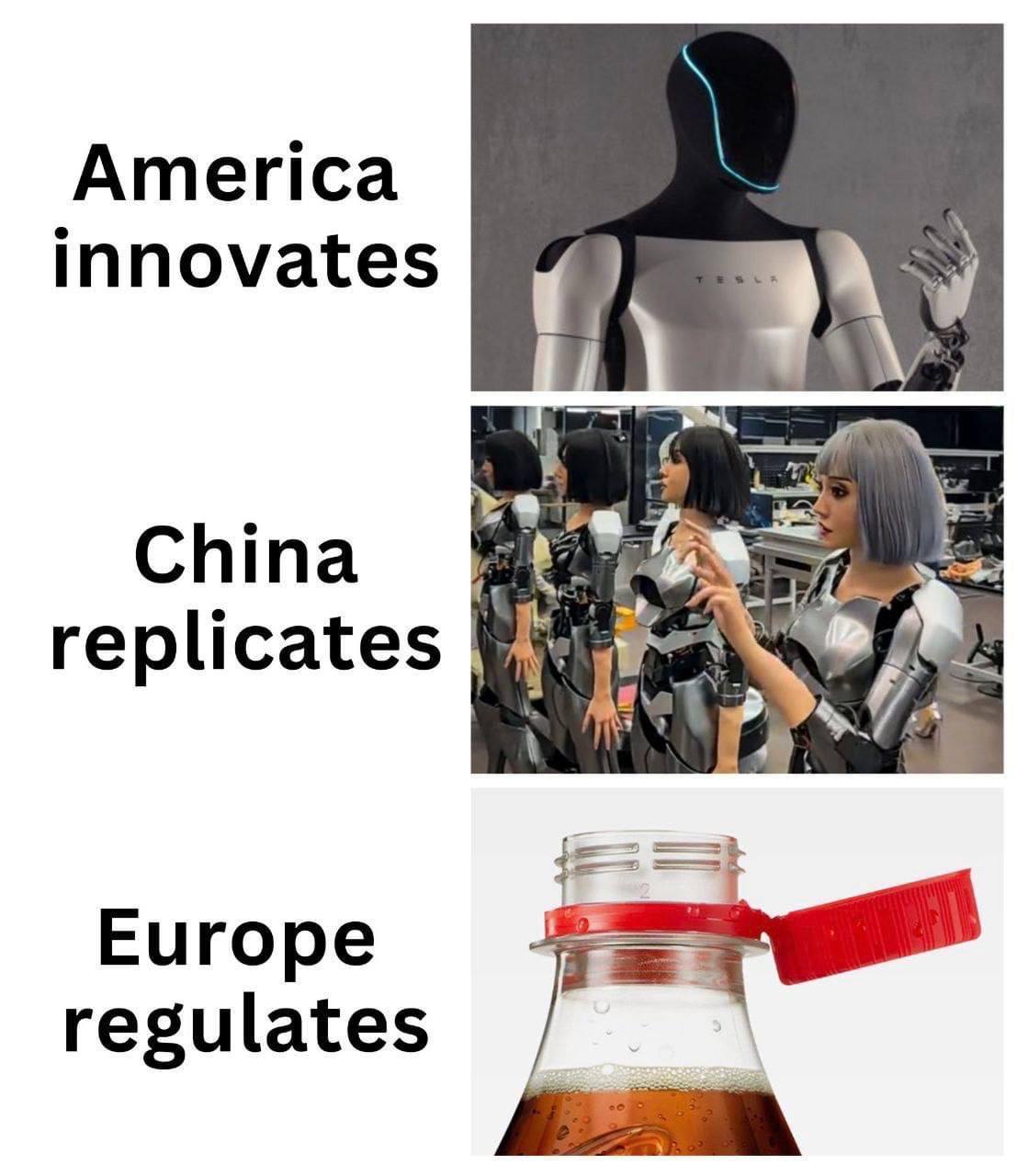
Look at the electric vehicle market. America built Tesla. China copied it, scaled it, and now dominates manufacturing. And the EU? The EU spent a decade writing regulations about what electric vehicles should look like, how they should be tested, and whether they should be allowed on the road at all.
Look at AI. America builds it. China adapts it. The EU writes an “AI Act” that nobody understands and everyone will end up breaking.
Look at crypto. America tolerates it. China bans it. The EU classifies it into seventeen categories and requires a passport.
The European Union — and by extension the UK that apes it — has become the world’s glorified HR department.
Its entire purpose is to identify risks, create committees, write guidelines, and slow everything down in the name of “protection.” It doesn’t build anything. It doesn’t make anything. It regulates things. It creates problems — “discrimination,” “data privacy concerns,” “algorithmic bias” — that didn’t exist until the regulators decided they needed to exist.
A View from the Inside
I got an email recently from a French AI engineer who left for San Francisco. She wrote to Anthropic and she made me stop and think. She called it what it is — not an environmental policy, not ecological prudence, but a theology. Original sin replaced by carbon footprint. Hell replaced by warming. Alms replaced by sobriety. The clergy replaced by “climate engineers” calculating the moral weight of every hamburger.
She took a scene from a meeting at Bercy — the French Ministry of Economy. A Mistral delegation was there to talk about “AI sovereignty.” Six senior officials around the table, all from the same schools, all agreeing on everything. Then she said: “We’ll need to build data centres in France if we want to seriously train tomorrow’s models.”
Short silence. Then a woman, with a sorry smile: “The French aren’t ready to accept such a footprint.”
She asked which one exactly. Answer: “Water consumption, electricity consumption, the signal sent.”
She reminded them France has the world’s second-most decarbonised electricity thanks to nuclear power — and that a modern data centre uses less water than a golf course in Provence.
Re-silence. Someone saved the situation by mentioning “more sober models.” Everyone nodded. She left.
Four months later, Microsoft announced €4 billion in investment in France. Not in training data centres where value is created. In inference data centres — to serve models trained elsewhere.
France, digital subcontractor to California. And everyone thought it was wonderful.
The Carbon Accountancy Trick
Here’s what degrowth actually produces. Not a saved planet. A vassalisation.
We refuse to produce at home, so we import. We refuse to refine at home, so we buy already-refined oil. We refuse to extract at home, so we depend on Chile and Congo. We refuse to manufacture at home, so we import from China via heavy fuel oil tankers.
At every step, the planet’s real carbon footprint increases, and France’s accounting carbon footprint decreases.
That’s the central trick. We’ve displaced the pollution, not reduced it. And we call that “ecological transition.”
The UK does the same. It closed its steelworks, then shipped scrap metal to China for processing, then shipped the finished steel back. The accounting carbon footprint decreased. The real carbon footprint exploded.
Why AI is the Perfect Devil
AI today is the perfect incarnation of everything degrowth hates. It checks every box:
It consumes energy — immoral. It accelerates — dangerous. It destabilises jobs — cruel. It’s produced by ambitious entrepreneurs — suspect. It comes from the United States — imperialist. It promises abundance — excessive, hubristic, Promethean.
Check all six. You get the perfect devil.
And that’s why no major cutting-edge AI laboratory can sustainably emerge in France or the UK in the current climate. The mental climate is incompatible with the object.
You don’t grow olive trees in a freezer, even with the world’s best gardeners.
The Civilisation Question
She’s 29. She wants to spend the next forty years understanding how these machines work — making them safer, more interpretable, more aligned with what we actually want. She doesn’t want to spend the next forty years explaining to ethics committees why her work isn’t an ecological sin.
Life is too short. The historical window is too narrow.
AI will be built with or without us. If France wants to be part of it, it has months left to breathe a different air. If it prefers to stay in its “model of happy sobriety,” more power to it. But let it not be surprised in ten years by the role it’s already started to accept.
Museum hostess.
She’ll work on models that consume a lot of energy. And that will produce, in exchange, an understanding of the world, biology, climate, materials that our children will thank us for.
That’s the real economic calculation. Not the “carbon footprint of the prompt” that editorialists roughly calculate between two Paris-to-New York flights.
The civilisational footprint of renunciation.
And here’s the question she asked — the one that sits at the bottom of all of this:
How can a civilisation survive if it sacrifices its vital forces? If it disincentivises work?
The prophet Jeremiah had an answer for that too. “My people are fools, they do not know me.” (Jeremiah 2:10) The diagnosis is older than any regulatory framework. A people that stops trusting the things it should trust — work, innovation, the God-given capacity to build and create — is a people that has already begun to disappear.
The world is accelerating. The ones who understand that will cut through. The ones who don’t will become museum hostesses.
Maranatha. Come, Lᴏʀᴅ Jesus. The clock is ticking, and the bureaucrats are running out of time.